Thursday, July 9, 2009
At Today
Today, I went to school. I had really great fun. I went to school at about twelve fifteen. When I reached school, I went to take care of the class. After a while, we went into the classroom. It was neatly tidied. I went to my seat, grabbed my termometer and took my temperature. At recess, I played with Jun Hui Badminton. It was fun. But I was very lousy.I kept missing the hit. Then I got a idea. I threw up the shutercock and hit it as hard as I can. It hit the ceiling because we were playing at the bus bay. After recess we went back to class. Jun Hui is going to bring four badminton rackets tommorow. Park and Jee Ming will be joining us. I think we will have a great time. When the bell rang, we lined up. It was time to go home. I went home feeling very happy. I had taekwondo at 8pm so I need to rush home. After my taekwondo lesson, I did some of my homework and then went to bed.

Monday, June 29, 2009
About My School Holidays
During the school holidays, I went to malaysia for 4 days. I went to my grandparent's house. I had enjoy my trip to malaysia. It was a long trip. It took us one hour to drive us to malaysia. I played games there. I had a lot of fun. Then, my parents arrive to fetch me home. They went out for breakfast. I reached home at about 8pm. I had no time for my taekwondo lesson. It starts at 8pm sharp. So, I stayed at home. It was boring. I miss my grandparents very much. I hope I will be able to go to malaysia again.
Wednesday, May 20, 2009
Adventure At the Park Connector
Last Sunday, I went to the new park connector. it was named pang Sua park connector. My family all went there jogging. I was riding my scooter. It could go very fast. A bicycle can go faster than a scooter. Then I went to bicycle path. I had to ride slowly to wait for my father. I reached 200m in no time. Then, I began sweating. I was very hot. It was my first time to go to pang sua park connector. There were no slopes or anything at the first 2000metres. I was beginning to feel bored. I passed by lots of bridges and houses. It was quite a sight. After 2700m my father was beginning to feel very tired. he looked hot and he sweat alot. So he decided to turn around and go back home. The next day, I told yuh yang that i went to the park connector. He said he went there about thirty times. Tommorrow i am going to the park connector again. I will be meeting yuh yang but he said he will take the shortcut. I will take the long way, from the beginning of pang sua park. I really had a wonderful day.
Thursday, May 7, 2009
Who Could Run The fastest
Today I will tell you who could run the fastest in our class.
1: Ken Ming
2: Jeng Yee
3: Roysten
4: Park, Joon Hou
5: Yuh Yang
6: Kevin
7: Jun Hui
8: Asher
9: Teng Kang
10: Jerald
11: Rayden
12: Jiaxi
13: Malcolm
14: Ryan
15: Jee Ming
1: Ken Ming
2: Jeng Yee
3: Roysten
4: Park, Joon Hou
5: Yuh Yang
6: Kevin
7: Jun Hui
8: Asher
9: Teng Kang
10: Jerald
11: Rayden
12: Jiaxi
13: Malcolm
14: Ryan
15: Jee Ming
Wednesday, May 6, 2009
About Me Today
Today I went to school. It was cool. I did alot of things. Today, assembly was in the Gallery and the Hall. I don't know why. Usually we go to the classrooms. I took care but today was not my duty as a pupil leader. Yuh Yang and I talked about the book, Gerinimo Stilton. He said he would borrow me some tommorow. After the pledge taking, we went back to our class.
It was temperture taking time. We need to take our temperture. We need to do it two times a day. If anyone got fever, the teacher will send them home.After the temperture taking, we carried on with our lessons. Today we also got PE. But our PE teacher did not come to school. So, we did not have PE. I was feeling very very very very sad. Because friday no PE. I got examination on friday. Then, we went for recess. It was fun. I did not go to library. After recess, we went back to class. It was our Chinese lesson now. But we need to take the temperture one more time. After that, the class monitress took the temperture taking paper and bring it to the gerneral office. After that, we went for our chinese lesson. I was in three Exc. Our teacher was sometimes fierce and sometimes ver very kind. I think I am lucky to have a very kind and caring chinese teacher.
After the chinese lesson, I went back to my form class.We had English. It was fun. But, we never do any English exercise. After that, we went back home. We lined up in twos. We walked quietly down the stairs. I and yuh yang waited until everybody gone down to second floor. Then we walked down the stairs. Today in class, Yuh Yang use his hands and formed a gun. He was firing it at me.When we rached the parade square, we put our bags down. Next, we sang the national athem. I sang loud and clear. Wieana sang the loudest. After we sang the national athem, our teacher guided us to the exit. my mother was waiting for me there. Quickly, I went to my mother and we went home happily. When we reached home, it was about seven pm. It was very late. I did not took a shower and washed my hands with soap and ate some ikan billis. It was very delicious. I also watched pokemon. After watching, I went to take a shower. After the shower, I went to eat at about seven forty-five. After I ate, I was posting right now. I hope I can use my computer tommorow. I want to post my blogs somemore!!!!!
Tuesday, May 5, 2009
School Day again
I went to school today. I love to go school. I meet lots of new friends for example, yuhyang. He is one of my best friends. My bad friend is Jun Hui. He pushes me, beat me but softly. I also scold him. At recess, I had a lot of fun. I went to library but it was closed.Then the bell rang. I went back to class slowly. I also had PE. I threw my frisby in the air. It was cool. fun. After that, we went back to class. I was the slowest. Then, it was HE. It was very fun. I went to toilet. I saw my form teacher screamiming at somebody who had just vommited in the toilet. I went back to class. After HE, it was 6.30. Thime to go to home sweet home. I was very glad. Today also we got temperture taking two times. We are scared that I had feer. Those who had fever must be sent back home immediately.
Sunday, May 3, 2009
The amazing thing ever saw
Today at night, there was a black bird in my house.It was very funny. My Daddy and I went to change our clothes in the room. To my amazing surprise, I saw a bird outside the window!!! It flew around the room, like a mad bird. All its feathers dropped on the bed, floor, mattres, on the painting and on the pillow!!!!My Mummy wanted to use the cane to bit it, but my father stopped her.My Daddy did not want my mummy to kill the bird. (This story is really true.) My Daddy grabbed hold of the bird, threw it out the window, and shut the window tightly. What a mess!! Mummy was really angry. She demanded Daddy to clean up this mess immediately. I was also in this mess. My Mummy was scard that got bird flu. She also helped me to clean up. The bird even shit on the floor. My mother was fired up. After this, I watched X-men vs the Brotherhood The Last Stand. It was really cool. I think the X men newest is X men orgins. Anyway I need to do homework. I will post later or tommorow.
Monday, April 27, 2009
about my friend

My friend id Yuh yang. He is very cute. Very handsome. He knows about alot of things. I will let you see a picture of him.
A Penknife
A penknife is very sharp. It may poke your hands and blood will come out. A panknife is for cuttiong things. Like paper, newspaper. But be careful!!! It is a small folding pocket penknife.
Rifle
A rifle is a firearm designed to be fired from the shoulder, with a barrel that has a helical groove or pattern of grooves ("rifling") cut into the barrel walls. The raised areas of the rifling are called "lands," which make contact with the projectile (for small arms usage, called a bullet), imparting spin around an axis corresponding to the orientation of the weapon. When the projectile leaves the barrel, the conservation of angular momentum improves accuracy and range, in the same way that a properly thrown American football or rugby ball behaves. The word "rifle" originally referred to the grooving, and a rifle was called a "rifled gun." Rifles are used in warfare, hunting and shooting sports.
Typically, a bullet is propelled by the contained deflagration of an explosive compound (originally black powder, later cordite, and now nitrocellulose), although other means such as compressed air are used in air rifles, which are popular for vermin control, hunting small game, and casual shooting ("plinking").
In most armed forces the term "gun" is incorrect when referring to small arms; in the military, the word "gun" means an artillery piece or crew-served machine gun. Furthermore, in many works of fiction a rifle refers to any weapon that has a stock and is shouldered before firing, even if the weapon is not rifled or does not fire solid projectiles.
Rifles traditionally fired a single projectile with each pull of the trigger. Modern assault rifles are capable of firing in bursts or fully automatic modes, and thus overlap somewhat with machine guns. In fact, many light machine guns (such as the Russian RPK) are adaptations of existing assault rifle designs. Generally, the difference between an automatic rifle and a machine gun comes down to weight and feed system; rifles, with their relatively light components (which overheat quickly) and small magazines, are incapable of sustained automatic fire in the way that machine guns are. Generally the rifle is an individual weapon, while the machine gun is crew-served: that is, at least two soldiers are dedicated to carrying and operating it.
Baker rifle
M1903 Springfield
G3 rifle
Contents[hide]
1 Overview
1.1 Bullet RPM
2 History
2.1 Origins
2.2 First designs
3 19th century
3.1 Minié
3.2 Bullet design
4 20th century
4.1 WWII
4.2 History of use
4.3 Modern civilian use
5 See also
5.1 Kinds of rifles
6 References
7 External links
//
[edit] Overview
Rifling in a .35 Remington microgroove rifled barrel.
Rifles were created as an improvement to smooth bore muskets. In the early 18th century, Benjamin Robins, an English mathematician, realized that an elongated bullet would retain the mass and kinetic force of a musket ball, but would slice through the air with greater ease.[1] The black powder used in early muzzle loading rifles quickly fouled the barrel, making loading slower and more difficult. Their greater range was also considered to be of little practical use, since the smoke from black powder quickly obscured the battlefield and made it almost impossible to target the enemy from a distance. Since musketeers could not afford to take the time to stop and clean their barrels in the middle of a battle, rifles were limited to use by sharpshooters and non-military uses like hunting.
The invention of the minie balls in the 1840s solved the slow loading problem, and in the 1850s and 1860s rifles quickly replaced muskets on the battlefield. Many rifles, often referred to as rifled muskets, were very similar to the muskets they replaced, but the military also experimented with other designs. Breech loading weapons proved to have a much faster rate of fire than muzzle loaders, causing military forces to abandon muzzle loaders in favor of breech loading designs in the late 1860s. In the later part of the 19th century, rifles were generally single-shot, breech-loading — designed for aimed, discretionary fire by individual soldiers. Then, as now, rifles had a stock, either fixed or folding, to be braced against the shoulder when firing. Early military rifles, such as the Baker rifle were shorter than the day's muskets, and usually the weapon of a marksman. Until the early 20th century rifles tended to be very long; an 1890 Martini-Henry was almost 2 m (6 ft) in length with a fixed bayonet. The demand for more compact weapons for cavalrymen led to the carbine, or shortened rifle.
[edit] Bullet RPM
Bullets leaving a rifled barrel can spin at over 300,000rpm depending on the muzzle velocity of the bullet and the pitch of the rifling. The rotational speed of the bullet can be calculated by using the formula below where MV is muzzle velocity. A bullet with a muzzle velocity of 3000 feet per second leaving a barrel that twists once per foot would rotate at 180,000rpm.[2]
MV x (12/twist rate in inches) x 60 = Bullet RPM
Example [Barrel is a 1/8 Twist, the bullets MV is 3000]
3000 x (12/8) x 60 = 270,000
Excessive rotational speed can exceed the bullet's designed limits and the resulting centrifugal force can cause the bullet to disintegrate in a radial fashion. [3]
[edit] History
[edit] Origins
Muskets were smoothbore, large caliber weapons using ball-shaped ammunition fired at relatively low velocity. Due to the high cost and great difficulty of precision manufacturing, and the need to load readily from the muzzle, the musket ball was a loose fit in the barrel. Consequently on firing the ball bounced off the sides of the barrel when fired and the final direction on leaving the muzzle was unpredictable.
The performance of early muskets was sufficient for the styles of warfare at the time, whereby soldiers tended to stand in long, stationary lines and fire at the opposing forces. Aiming and accuracy were not necessary to hit an opponent.
The origins of rifling are difficult to trace, but some of the earliest practical experiments seem to have occurred in Europe during the fifteenth century. Archers had long realized that a twist added to the tail feathers of their arrows gave them greater accuracy. Early muskets produced large quantities of smoke and soot, which had to be cleaned from the action and bore of the musket frequently; either through the action of repeated bore scrubbing, or a deliberate attempt to create "soot grooves" that would allow for more shots to be fired from the firearm might also have led to a perceived increase in accuracy, although no one knows for sure. True rifling dates from the mid-15th century, although the precision required for its effective manufacture kept it out of the hands of infantrymen for another three and a half centuries, when it largely replaced the unrifled musket as the primary infantry weapon. In the transitional nineteenth century, the term "rifled musket" was used to indicate the novel weapon. During the Napoleonic Wars the British army created several experimental units known as "Rifles", armed with the Baker rifle. These Rifle Regiments were deployed as skirmishers during the Peninsular war in Spain and Portugal, and were more effective than skirmishers armed with muskets due to their accuracy and long range.
[edit] First designs
Some early rifled guns were created with special barrels that had a twisted polygonal shape, in particular the Whitworth rifle was the first to be made with the intention of spinning the round for the use of as a "rifle". Specially-made bullets were designed to match the shape so the bullet would grip the rifle bore and take a spin that way. These were generally limited to large caliber weapons and the ammunition still did not fit tightly in the barrel. Many experimental designs used different shapes and degrees of spiraling; one widely-produced example was the Metford rifling in the Pattern 1888 Lee-Metford service rifle. Although uncommon, polygonal rifling is still used in some weapons today with one example being the Glock line of pistols (which fire standard bullets). Unfortunately, many early attempts resulted in dangerous backfiring, which could lead to destruction of the weapon and serious injury to the person firing.
[edit] 19th century
Gradually, rifles appeared with cylindrical barrels cut with helical grooves, the surfaces between the grooves being "lands". The innovation shortly preceded the mass adoption of breech-loading weapons, as it was not practical to push an overbore bullet down through a rifled barrel, only to then (try to) fire it back out. The dirt and grime from prior shots was pushed down ahead of a tight bullet or ball (which may have been a loose fit in the clean barrel before the first shot), and, of course, loading was far more difficult, as the lead had to be deformed to go down in the first place, reducing the accuracy due to deformation. Several systems were tried to deal with the problem, usually by resorting to an under-bore bullet that expanded upon firing.
The original muzzle-loading rifle, with a closely fitting ball to take the rifling grooves, was loaded with difficulty, particularly when foul, and for this reason was not generally used for military purposes. Even with the advent of rifling the bullet itself didn't change, but was wrapped in a greased, cloth patch to grip the rifling grooves.
The first half of the nineteenth century saw a distinct change in the shape and function of the bullet. In 1826 Delirque, a French infantry officer, invented a breech with abrupt shoulders on which a spherical bullet was rammed down until it caught the rifling grooves. Delirque's method, however, deformed the bullet and was inaccurate.
[edit] Minié
One of the most famous was the Minié system, which relied on a conical bullet (known as a Minié ball) with a hollow skirt at the base of the bullet. When fired, the skirt would expand from the pressure of the exploding charge and grip the rifling as the round was fired. The better seal gave more power, as less gas escaped past the bullet, which combined with the fact that for the same bore (caliber) diameter a long bullet was heavier than a round ball. The extra grip also spun the bullet more consistently, which increased the range from about 50 yards for a smooth bore musket to about 300 yards for a rifle using the Minié system. The expanding skirt of the Minié ball also solved the problem that earlier tight fitting bullets were difficult to load as black powder residue fouled the inside of the barrel. The Minié system allowed conical bullets to be loaded just as quickly as round balls in smooth bullets, which allowed rifles to replace muskets on the battlefield. Minié system rifles, notably the U.S. Springfield and the British Enfield of the early 1860s, featured prominently in the U.S. Civil War, due to the enhanced power and accuracy.
Another important area of development was the way that cartridges were stored and used in the weapon. The Spencer repeating rifle was a breech-loading manually operated lever action rifle, that was adopted by the United States. Over 20,000 were used during the Civil War. It marked the first adoption of a removable magazine-fed infantry rifle by any country. The design was completed by Christopher Spencer in 1860.[citation needed] It used copper rimfire cartridges stored in a removable seven round tube magazine, enabling the rounds to be fired one after another. When the magazine was empty, it could be exchanged for another.
As the bullet enters the barrel, it inserts itself into the rifling, a process that gradually wears down the barrel, and also causes the barrel to heat up more rapidly. Therefore, some machine-guns are equipped with quick-change barrels that can be swapped every few thousand rounds, or in earlier designs, were water-cooled. Unlike older carbon steel barrels, which were limited to around 1,000 shots before the extreme heat caused accuracy to fade, modern stainless steel barrels for target rifles are much more resistant to wear, allowing many thousands of rounds to be fired before accuracy drops. (Many shotguns and small arms have chrome-lined barrels to reduce wear and enhance corrosion resistance. This is rare on rifles designed for extreme accuracy, as the plating process is difficult and liable to reduce the effect of the rifling.) Modern ammunition has hardened leadcore with a softer outer cladding or jacket, typically of an alloy of copper and nickel - cupro-nickel. Some ammunition is even coated with molybdenum-disulfide to further reduce internal friction - the so-called 'moly-coated' bullet.[citation needed]
[edit] Bullet design
Over the 19th century, bullet design also evolved, the bullets becoming gradually smaller and lighter. By 1910 the standard blunt-nosed bullet had been replaced with the pointed, 'spitzer' bullet, an innovation that increased range and penetration. Cartridge design evolved from simple paper tubes containing black powder and shot, to sealed brass cases with integral primers for ignition, while black powder itself was replaced with cordite, and then other nitro-cellulose-based smokeless powder mixtures, propelling bullets to higher velocities than before.[4]
The increased velocity meant that new problems arrived, and so bullets went from being soft lead to harder lead, then to copper jacketed, in order to better engage the spiraled grooves without "stripping" them in the same way that a screw or bolt thread would be stripped if subjected to extreme forces.
[edit] 20th century
As mentioned above, rifles were initially single-shot, muzzle-loading weapons. During the 18th century, breech-loading weapons were designed, which allowed the rifleman to reload while under cover, but defects in manufacturing and the difficulty in forming a reliable gas-tight seal prevented widespread adoption. During the 19th century, multi-shot repeating rifles using lever, pump or linear bolt actions became standard, further increasing the rate of fire and minimizing the fuss involved in loading a firearm. The problem of proper seal creation had been solved with the use of brass cartridge cases, which expanded in an elastic fashion at the point of firing and effectively sealed the breech while the pressure remained high, then relaxed back enough to allow for easy removal. By the end of the 19th century, the leading bolt-action design was that of Paul Mauser, whose action—wedded to a reliable design possessing a five-shot magazine—became a world standard through two world wars and beyond. The Mauser rifle was paralleled by Britain's ten-shot Lee-Enfield and America's 1903 Springfield Rifle models (the latter pictured above). The American M1903 closely copied Mauser's original design.
The advent of massed, rapid firepower and of the machine gun and the rifled artillery piece was so quick as to outstrip the development of any way to attack a trench defended by riflemen and machine gunners. The carnage of World War I was perhaps the greatest vindication and vilification of the rifle as a military weapon. By World War II, military thought was turning elsewhere, towards more compact weapons.
[edit] WWII
Experience in World War I led German military researchers to conclude that long-range aimed fire was less significant at typical battle ranges of 300 m. As mechanisms became smaller, lighter and more reliable, semi-automatic rifles, including the M1 Garand, appeared. World War II saw the first mass-fielding of such rifles, which culminated in the Sturmgewehr 44, the first assault rifle and one of the most significant developments of 20th century small-arms.
By contrast, civilian rifle design has not significantly advanced since the early part of the 20th century. Modern hunting rifles have fiberglass and carbon fiber stocks and more advanced recoil pads, but are fundamentally the same as infantry rifles from 1910. Many modern sniper rifles can trace their ancestry back for well over a century, and the Russian 7.62 x 54 mm cartridge, as used in the front-line Dragunov Sniper Rifle (SVD), dates from 1891.
[edit] History of use
Muskets were used for comparatively rapid, unaimed volley fire, and the average conscripted soldier could be easily trained to use them. The (muzzle-loaded) rifle was originally a sharpshooter's weapon used for targets of opportunity and deliberate aimed fire. During the Napoleonic Wars, the British 95th Regiment (Green Jackets) and 60th Regiment (Royal American) used the rifle to great effect during skirmishing. Because of a slower loading time than a musket, they were not adopted by the whole army. The adoption of cartridges and breech-loading in the 19th century was concurrent with the general adoption of rifles. In the early part of the 20th century, soldiers were trained to shoot accurately over long ranges with high-powered cartridges. World War I Lee-Enfields rifles (among others) were equipped with long-range 'volley sights' for massed firing at ranges of up to 1.6 km (1.0 mile). Individual shots were unlikely to hit, but a platoon firing repeatedly could produce a 'beaten ground' effect similar to light artillery or machine guns; but experience in WWI showed that long-range fire was best left to the machine gun.
During and after WWII it became accepted that most infantry engagements occur at ranges of less than 300 m; the range and power of the large rifles was "overkill"; and the weapons were heavier than the ideal. This led to Germany's development of the 7.92 x 33 mm Kurz (short) round, the Karabiner 98, the MKb-42, and ultimately, the assault rifle. Today, an infantryman's rifle is optimised for ranges of 300 m or less, and soldiers are trained to deliver individual rounds or bursts of fire within these distances. The application of accurate, long-range fire is the domain of the sniper in warfare, and of enthusiastic target shooters in peacetime. The modern sniper rifle is usually capable of accuracy better than 0.3 mrad (1 arcminute).
In recent decades, large-caliber anti-materiel rifle's, typically firing 12.7 mm and 20 mm caliber cartridges, have been developed. The US Barrett M82A1 is probably the best-known such rifle. These weapons are typically used to strike critical, vulnerable targets such as computerized command and control vehicles, radio trucks, radar antennae, vehicle engine blocks and the jet engines of enemy aircraft. Anti-materiel rifles can be used against human targets, but the much higher weight of rifle and ammunition, and the massive recoil and muzzle blast, usually make them less than practical for such use. The Barrett M82 is credited with a maximum effective range of 1800 m (1.1 mile); and it was with a .50BMG caliber McMillan TAC-50 rifle that Canadian Master Corporal Rob Furlong made the longest recorded confirmed sniper kill in history, when he shot a Taliban insurgent at a range of 2,430 meters (1.51 miles) in Afghanistan during Operation Anaconda in 2002.[5]
[edit] Modern civilian use
Modern hunting rifle
Currently, rifles are the most common firearm in general use for hunting purposes (with the exception of bird hunting where shotguns are favored). Use in competition is also very common, and includes Olympic events. Rifles derived from military designs have always been popular with civilian shooters, and today semi-automatic versions of modern military rifles such as the AR-15 or AK-47 have become very popular in the United States for target shooting and sporting purposes despite the 1994 Federal Assault Weapons Ban which restricted their manufacture to some degree until 2004, when it expired. In other countries however, the ownership of these types of rifles may be restricted by law, and so single-shot or bolt-action rifles are common instead.
[edit] See also
British military rifles
Pistol
Shotgun
Antique guns
Rifle range
Gun safety
Rifle grenade
List of rifle cartridges
Rifling
Service rifle
List of service rifles of national armies
Objective Individual Combat Weapon program
[edit] Kinds of rifles
Air rifle
Spencer rifle
Semi-automatic rifle
Automatic rifle
Assault rifle; List of assault rifles
Anti-materiel rifle
Battle rifle
Bolt action
Carbine
Double rifle
Lloyd rifle
Musket
Repeating rifle
Recoilless rifle
Sniper rifle; List of sniper rifles
Long rifle
Lever-action
Typically, a bullet is propelled by the contained deflagration of an explosive compound (originally black powder, later cordite, and now nitrocellulose), although other means such as compressed air are used in air rifles, which are popular for vermin control, hunting small game, and casual shooting ("plinking").
In most armed forces the term "gun" is incorrect when referring to small arms; in the military, the word "gun" means an artillery piece or crew-served machine gun. Furthermore, in many works of fiction a rifle refers to any weapon that has a stock and is shouldered before firing, even if the weapon is not rifled or does not fire solid projectiles.
Rifles traditionally fired a single projectile with each pull of the trigger. Modern assault rifles are capable of firing in bursts or fully automatic modes, and thus overlap somewhat with machine guns. In fact, many light machine guns (such as the Russian RPK) are adaptations of existing assault rifle designs. Generally, the difference between an automatic rifle and a machine gun comes down to weight and feed system; rifles, with their relatively light components (which overheat quickly) and small magazines, are incapable of sustained automatic fire in the way that machine guns are. Generally the rifle is an individual weapon, while the machine gun is crew-served: that is, at least two soldiers are dedicated to carrying and operating it.

Baker rifle

M1903 Springfield

G3 rifle
Contents[hide]
1 Overview
1.1 Bullet RPM
2 History
2.1 Origins
2.2 First designs
3 19th century
3.1 Minié
3.2 Bullet design
4 20th century
4.1 WWII
4.2 History of use
4.3 Modern civilian use
5 See also
5.1 Kinds of rifles
6 References
7 External links
//
[edit] Overview

Rifling in a .35 Remington microgroove rifled barrel.
Rifles were created as an improvement to smooth bore muskets. In the early 18th century, Benjamin Robins, an English mathematician, realized that an elongated bullet would retain the mass and kinetic force of a musket ball, but would slice through the air with greater ease.[1] The black powder used in early muzzle loading rifles quickly fouled the barrel, making loading slower and more difficult. Their greater range was also considered to be of little practical use, since the smoke from black powder quickly obscured the battlefield and made it almost impossible to target the enemy from a distance. Since musketeers could not afford to take the time to stop and clean their barrels in the middle of a battle, rifles were limited to use by sharpshooters and non-military uses like hunting.
The invention of the minie balls in the 1840s solved the slow loading problem, and in the 1850s and 1860s rifles quickly replaced muskets on the battlefield. Many rifles, often referred to as rifled muskets, were very similar to the muskets they replaced, but the military also experimented with other designs. Breech loading weapons proved to have a much faster rate of fire than muzzle loaders, causing military forces to abandon muzzle loaders in favor of breech loading designs in the late 1860s. In the later part of the 19th century, rifles were generally single-shot, breech-loading — designed for aimed, discretionary fire by individual soldiers. Then, as now, rifles had a stock, either fixed or folding, to be braced against the shoulder when firing. Early military rifles, such as the Baker rifle were shorter than the day's muskets, and usually the weapon of a marksman. Until the early 20th century rifles tended to be very long; an 1890 Martini-Henry was almost 2 m (6 ft) in length with a fixed bayonet. The demand for more compact weapons for cavalrymen led to the carbine, or shortened rifle.
[edit] Bullet RPM
Bullets leaving a rifled barrel can spin at over 300,000rpm depending on the muzzle velocity of the bullet and the pitch of the rifling. The rotational speed of the bullet can be calculated by using the formula below where MV is muzzle velocity. A bullet with a muzzle velocity of 3000 feet per second leaving a barrel that twists once per foot would rotate at 180,000rpm.[2]
MV x (12/twist rate in inches) x 60 = Bullet RPM
Example [Barrel is a 1/8 Twist, the bullets MV is 3000]
3000 x (12/8) x 60 = 270,000
Excessive rotational speed can exceed the bullet's designed limits and the resulting centrifugal force can cause the bullet to disintegrate in a radial fashion. [3]
[edit] History
[edit] Origins
Muskets were smoothbore, large caliber weapons using ball-shaped ammunition fired at relatively low velocity. Due to the high cost and great difficulty of precision manufacturing, and the need to load readily from the muzzle, the musket ball was a loose fit in the barrel. Consequently on firing the ball bounced off the sides of the barrel when fired and the final direction on leaving the muzzle was unpredictable.
The performance of early muskets was sufficient for the styles of warfare at the time, whereby soldiers tended to stand in long, stationary lines and fire at the opposing forces. Aiming and accuracy were not necessary to hit an opponent.
The origins of rifling are difficult to trace, but some of the earliest practical experiments seem to have occurred in Europe during the fifteenth century. Archers had long realized that a twist added to the tail feathers of their arrows gave them greater accuracy. Early muskets produced large quantities of smoke and soot, which had to be cleaned from the action and bore of the musket frequently; either through the action of repeated bore scrubbing, or a deliberate attempt to create "soot grooves" that would allow for more shots to be fired from the firearm might also have led to a perceived increase in accuracy, although no one knows for sure. True rifling dates from the mid-15th century, although the precision required for its effective manufacture kept it out of the hands of infantrymen for another three and a half centuries, when it largely replaced the unrifled musket as the primary infantry weapon. In the transitional nineteenth century, the term "rifled musket" was used to indicate the novel weapon. During the Napoleonic Wars the British army created several experimental units known as "Rifles", armed with the Baker rifle. These Rifle Regiments were deployed as skirmishers during the Peninsular war in Spain and Portugal, and were more effective than skirmishers armed with muskets due to their accuracy and long range.
[edit] First designs
Some early rifled guns were created with special barrels that had a twisted polygonal shape, in particular the Whitworth rifle was the first to be made with the intention of spinning the round for the use of as a "rifle". Specially-made bullets were designed to match the shape so the bullet would grip the rifle bore and take a spin that way. These were generally limited to large caliber weapons and the ammunition still did not fit tightly in the barrel. Many experimental designs used different shapes and degrees of spiraling; one widely-produced example was the Metford rifling in the Pattern 1888 Lee-Metford service rifle. Although uncommon, polygonal rifling is still used in some weapons today with one example being the Glock line of pistols (which fire standard bullets). Unfortunately, many early attempts resulted in dangerous backfiring, which could lead to destruction of the weapon and serious injury to the person firing.
[edit] 19th century
Gradually, rifles appeared with cylindrical barrels cut with helical grooves, the surfaces between the grooves being "lands". The innovation shortly preceded the mass adoption of breech-loading weapons, as it was not practical to push an overbore bullet down through a rifled barrel, only to then (try to) fire it back out. The dirt and grime from prior shots was pushed down ahead of a tight bullet or ball (which may have been a loose fit in the clean barrel before the first shot), and, of course, loading was far more difficult, as the lead had to be deformed to go down in the first place, reducing the accuracy due to deformation. Several systems were tried to deal with the problem, usually by resorting to an under-bore bullet that expanded upon firing.
The original muzzle-loading rifle, with a closely fitting ball to take the rifling grooves, was loaded with difficulty, particularly when foul, and for this reason was not generally used for military purposes. Even with the advent of rifling the bullet itself didn't change, but was wrapped in a greased, cloth patch to grip the rifling grooves.
The first half of the nineteenth century saw a distinct change in the shape and function of the bullet. In 1826 Delirque, a French infantry officer, invented a breech with abrupt shoulders on which a spherical bullet was rammed down until it caught the rifling grooves. Delirque's method, however, deformed the bullet and was inaccurate.
[edit] Minié
One of the most famous was the Minié system, which relied on a conical bullet (known as a Minié ball) with a hollow skirt at the base of the bullet. When fired, the skirt would expand from the pressure of the exploding charge and grip the rifling as the round was fired. The better seal gave more power, as less gas escaped past the bullet, which combined with the fact that for the same bore (caliber) diameter a long bullet was heavier than a round ball. The extra grip also spun the bullet more consistently, which increased the range from about 50 yards for a smooth bore musket to about 300 yards for a rifle using the Minié system. The expanding skirt of the Minié ball also solved the problem that earlier tight fitting bullets were difficult to load as black powder residue fouled the inside of the barrel. The Minié system allowed conical bullets to be loaded just as quickly as round balls in smooth bullets, which allowed rifles to replace muskets on the battlefield. Minié system rifles, notably the U.S. Springfield and the British Enfield of the early 1860s, featured prominently in the U.S. Civil War, due to the enhanced power and accuracy.
Another important area of development was the way that cartridges were stored and used in the weapon. The Spencer repeating rifle was a breech-loading manually operated lever action rifle, that was adopted by the United States. Over 20,000 were used during the Civil War. It marked the first adoption of a removable magazine-fed infantry rifle by any country. The design was completed by Christopher Spencer in 1860.[citation needed] It used copper rimfire cartridges stored in a removable seven round tube magazine, enabling the rounds to be fired one after another. When the magazine was empty, it could be exchanged for another.
As the bullet enters the barrel, it inserts itself into the rifling, a process that gradually wears down the barrel, and also causes the barrel to heat up more rapidly. Therefore, some machine-guns are equipped with quick-change barrels that can be swapped every few thousand rounds, or in earlier designs, were water-cooled. Unlike older carbon steel barrels, which were limited to around 1,000 shots before the extreme heat caused accuracy to fade, modern stainless steel barrels for target rifles are much more resistant to wear, allowing many thousands of rounds to be fired before accuracy drops. (Many shotguns and small arms have chrome-lined barrels to reduce wear and enhance corrosion resistance. This is rare on rifles designed for extreme accuracy, as the plating process is difficult and liable to reduce the effect of the rifling.) Modern ammunition has hardened leadcore with a softer outer cladding or jacket, typically of an alloy of copper and nickel - cupro-nickel. Some ammunition is even coated with molybdenum-disulfide to further reduce internal friction - the so-called 'moly-coated' bullet.[citation needed]
[edit] Bullet design
Over the 19th century, bullet design also evolved, the bullets becoming gradually smaller and lighter. By 1910 the standard blunt-nosed bullet had been replaced with the pointed, 'spitzer' bullet, an innovation that increased range and penetration. Cartridge design evolved from simple paper tubes containing black powder and shot, to sealed brass cases with integral primers for ignition, while black powder itself was replaced with cordite, and then other nitro-cellulose-based smokeless powder mixtures, propelling bullets to higher velocities than before.[4]
The increased velocity meant that new problems arrived, and so bullets went from being soft lead to harder lead, then to copper jacketed, in order to better engage the spiraled grooves without "stripping" them in the same way that a screw or bolt thread would be stripped if subjected to extreme forces.
[edit] 20th century
As mentioned above, rifles were initially single-shot, muzzle-loading weapons. During the 18th century, breech-loading weapons were designed, which allowed the rifleman to reload while under cover, but defects in manufacturing and the difficulty in forming a reliable gas-tight seal prevented widespread adoption. During the 19th century, multi-shot repeating rifles using lever, pump or linear bolt actions became standard, further increasing the rate of fire and minimizing the fuss involved in loading a firearm. The problem of proper seal creation had been solved with the use of brass cartridge cases, which expanded in an elastic fashion at the point of firing and effectively sealed the breech while the pressure remained high, then relaxed back enough to allow for easy removal. By the end of the 19th century, the leading bolt-action design was that of Paul Mauser, whose action—wedded to a reliable design possessing a five-shot magazine—became a world standard through two world wars and beyond. The Mauser rifle was paralleled by Britain's ten-shot Lee-Enfield and America's 1903 Springfield Rifle models (the latter pictured above). The American M1903 closely copied Mauser's original design.
The advent of massed, rapid firepower and of the machine gun and the rifled artillery piece was so quick as to outstrip the development of any way to attack a trench defended by riflemen and machine gunners. The carnage of World War I was perhaps the greatest vindication and vilification of the rifle as a military weapon. By World War II, military thought was turning elsewhere, towards more compact weapons.
[edit] WWII
Experience in World War I led German military researchers to conclude that long-range aimed fire was less significant at typical battle ranges of 300 m. As mechanisms became smaller, lighter and more reliable, semi-automatic rifles, including the M1 Garand, appeared. World War II saw the first mass-fielding of such rifles, which culminated in the Sturmgewehr 44, the first assault rifle and one of the most significant developments of 20th century small-arms.
By contrast, civilian rifle design has not significantly advanced since the early part of the 20th century. Modern hunting rifles have fiberglass and carbon fiber stocks and more advanced recoil pads, but are fundamentally the same as infantry rifles from 1910. Many modern sniper rifles can trace their ancestry back for well over a century, and the Russian 7.62 x 54 mm cartridge, as used in the front-line Dragunov Sniper Rifle (SVD), dates from 1891.
[edit] History of use
Muskets were used for comparatively rapid, unaimed volley fire, and the average conscripted soldier could be easily trained to use them. The (muzzle-loaded) rifle was originally a sharpshooter's weapon used for targets of opportunity and deliberate aimed fire. During the Napoleonic Wars, the British 95th Regiment (Green Jackets) and 60th Regiment (Royal American) used the rifle to great effect during skirmishing. Because of a slower loading time than a musket, they were not adopted by the whole army. The adoption of cartridges and breech-loading in the 19th century was concurrent with the general adoption of rifles. In the early part of the 20th century, soldiers were trained to shoot accurately over long ranges with high-powered cartridges. World War I Lee-Enfields rifles (among others) were equipped with long-range 'volley sights' for massed firing at ranges of up to 1.6 km (1.0 mile). Individual shots were unlikely to hit, but a platoon firing repeatedly could produce a 'beaten ground' effect similar to light artillery or machine guns; but experience in WWI showed that long-range fire was best left to the machine gun.
During and after WWII it became accepted that most infantry engagements occur at ranges of less than 300 m; the range and power of the large rifles was "overkill"; and the weapons were heavier than the ideal. This led to Germany's development of the 7.92 x 33 mm Kurz (short) round, the Karabiner 98, the MKb-42, and ultimately, the assault rifle. Today, an infantryman's rifle is optimised for ranges of 300 m or less, and soldiers are trained to deliver individual rounds or bursts of fire within these distances. The application of accurate, long-range fire is the domain of the sniper in warfare, and of enthusiastic target shooters in peacetime. The modern sniper rifle is usually capable of accuracy better than 0.3 mrad (1 arcminute).
In recent decades, large-caliber anti-materiel rifle's, typically firing 12.7 mm and 20 mm caliber cartridges, have been developed. The US Barrett M82A1 is probably the best-known such rifle. These weapons are typically used to strike critical, vulnerable targets such as computerized command and control vehicles, radio trucks, radar antennae, vehicle engine blocks and the jet engines of enemy aircraft. Anti-materiel rifles can be used against human targets, but the much higher weight of rifle and ammunition, and the massive recoil and muzzle blast, usually make them less than practical for such use. The Barrett M82 is credited with a maximum effective range of 1800 m (1.1 mile); and it was with a .50BMG caliber McMillan TAC-50 rifle that Canadian Master Corporal Rob Furlong made the longest recorded confirmed sniper kill in history, when he shot a Taliban insurgent at a range of 2,430 meters (1.51 miles) in Afghanistan during Operation Anaconda in 2002.[5]
[edit] Modern civilian use

Modern hunting rifle
Currently, rifles are the most common firearm in general use for hunting purposes (with the exception of bird hunting where shotguns are favored). Use in competition is also very common, and includes Olympic events. Rifles derived from military designs have always been popular with civilian shooters, and today semi-automatic versions of modern military rifles such as the AR-15 or AK-47 have become very popular in the United States for target shooting and sporting purposes despite the 1994 Federal Assault Weapons Ban which restricted their manufacture to some degree until 2004, when it expired. In other countries however, the ownership of these types of rifles may be restricted by law, and so single-shot or bolt-action rifles are common instead.
[edit] See also
British military rifles
Pistol
Shotgun
Antique guns
Rifle range
Gun safety
Rifle grenade
List of rifle cartridges
Rifling
Service rifle
List of service rifles of national armies
Objective Individual Combat Weapon program
[edit] Kinds of rifles
Air rifle
Spencer rifle
Semi-automatic rifle
Automatic rifle
Assault rifle; List of assault rifles
Anti-materiel rifle
Battle rifle
Bolt action
Carbine
Double rifle
Lloyd rifle
Musket
Repeating rifle
Recoilless rifle
Sniper rifle; List of sniper rifles
Long rifle
Lever-action
Flush Toilet
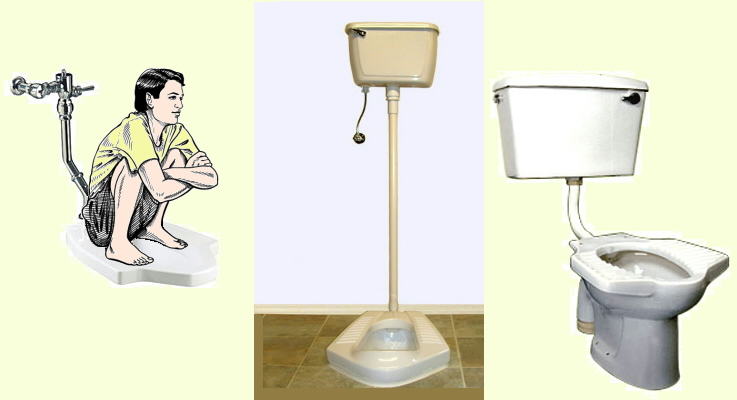
A flush toilet is a toilet that disposes of human waste by using water to flush it through a drainpipe to another location. Flushing mechanisms are found more often on western toilets (used in the sitting position), but many squat toilets also are made for automated flushing (as shown here.) Modern toilets incorporate an 'S' bend; this 'trap' creates a water seal which remains filled. The 'S' bend also provides siphon action which helps accelerate the flushing process. Water filling up the bowl creates a high pressure area which forces the water past the S bend. At the S bend when water starts to move it creates a vacuum that pulls the water and waste out of the toilet. When no more water is left then the air stops the siphon or vacuum process. At that point the water that is going into the bowl continues to fill up the bowl to equalize the bowl and the S bend. This ends the cycle of one flush. However, since this type of toilet does not generally handle waste on site, separate waste treatment systems must be built.
Contents[hide]
1 Invention timeline
2 The bowl
2.1 Washout pans
2.2 The bowl siphon
2.3 Valve closet
2.4 Cultural variations
2.5 Parts
3 Flushing mechanisms
3.1 Direct flush (flushometer)
3.2 Valve tank type
4 Low-flow and High Efficiency toilets
5 American Standard Timed Cup Flush Valve
6 One-Piece Fill Valve
6.1 Valveless siphon tank type
6.2 Pressure-assisted
6.3 Automatic flush
6.4 Manual operation
6.5 Flush Repair
6.6 "The Flush"
6.7 Water closet (WC)
6.8 Flushing direction
7 See also
8 References
9 External links
//
[edit] Invention timeline
Toilet with elevated cistern and chain attached to lever of discharge valve.
As with many inventions, the flush toilet did not suddenly spring into existence, but was the result of a long chain of minor improvements. Therefore, instead of a single name and date, there follows a list of significant contributors to the history of the device.
circa 26th century BC: Flush toilets were first used in the Indus Valley Civilization. The cities of Harappa and Mohenjo-daro had a flush toilet in almost every house, attached to a sophisticated sewage system. [1]
circa 18th century BC: Flush toilet constructed at Knossos on Minoan Crete[2]
circa 15th century BC: Flush toilets used in the Minoan city of Akrotiri.[citation needed]
9th century BC: Flush toilets in Bahrain Island.[3]
1st to 5th centuries AD: Flush toilets were used throughout the Roman Empire. Some examples include those at Vindolanda on Hadrian's Wall in Britain. With the fall of the Roman Empire, the technology was lost in the West.[citation needed]
1596: Sir John Harington published A New Discourse of a Stale Subject, Called the Metamorphosis of Ajax, describing a forerunner to the modern flush toilet. The design had a flush valve to let water out of the tank, and a wash-down design to empty the bowl. He installed one for his godmother Elizabeth I of England at Richmond Palace, although she refused to use it because it made too much noise[citation needed]. The Ajax was not taken up on a wide scale in England, but was adopted in France under the name Angrez.
1738: A valve-type flush toilet was invented by J. F. Brondel.
1775: Alexander Cummings invented the S-trap (British patent no. 814?), still in use today, which uses standing water to seal the outlet of the bowl, preventing the escape of foul air from the sewer. His design had a sliding valve in the bowl outlet above the trap.
1777: Samuel Prosser invented and patented the 'plunger closet'.
1778: Joseph Bramah invented a hinged valve or 'crank valve' that sealed the bottom of the bowl, and a float valve system for the flush tank. His design was used mainly on boats.
1819: Albert Giblin received British patent 4990 for the "Silent Valveless Water Waste Preventer", a siphon discharge system.
1852: J. G. Jennings invented a wash-out design with a shallow pan emptying into an S-trap.
1857: The first American patent for a toilet, the 'plunger closet', was granted.
1860: The first watercloset installed on the European continent was imported from England. It was installed in the rooms of Queen Victoria in castle Ehrenburg (Coburg, Germany); she was the only one who was allowed to use it.
The first popularized water closets were exhibited at The Crystal Palace and these became the first public toilets. They had attendants dressed in white and customers were charged a penny for use. This is the origin of the phrase "To spend a penny".
1880s: Thomas Crapper's plumbing company built flush toilets of Giblin's design. After the company received a royal warrant, Crapper's name became synonymous with flush toilets. Although he was not the original inventor, Crapper popularized the siphon system for emptying the tank, replacing the earlier floating valve system which was prone to leaks. Some of Crapper's designs were made by Thomas Twyford. The similarity between Crapper's name and the much older word crap is merely a coincidence.
1885: Thomas Twyford built the first one-piece china toilet using the flush-out siphon design by J. G. Jennings.
1886: An early jet flush toilet was manufactured by the Beaufort Works in Chelsea, England.
1906: William Elvis Sloan invents the Flushometer which uses pressurized water directly from the supply line for faster recycle time between flushes. The original Royal Flushometer is still in use today in public restrooms worldwide.
1907: Thomas MacAvity Stewart of Saint John, New Brunswick patents the vortex-flushing toilet bowl which creates a self cleansing effect.[4]
1980: Bruce Thompson, working for Caroma in Australia, developed the Duoset cistern with two buttons and two flush volumes as a water-saving measure. Modern versions of the Duoset are now available in more than 30 countries worldwide, and save the average household 67% of their normal water usage.[5]
[edit] The bowl
The bowl, loo or pan, of a toilet is the receptacle into which body waste is excreted; the pan is usually made of porcelain, but sometimes made of stainless steel or composite plastics. Toilet bowls may be pedestal (free-standing), cantilever (wall-hung), or squat in design. There are several types of pans in common use: washdown, washout, and siphon. In less common use is the valve closet. There are "male" and "female" bowls also. Males prefer the larger, elongated (or oval) bowls for "penis clearance" while sitting for defecation. This is more sanitary since the penis is clear of the bowl, rim and usually elongated seat. The outer edge of a toilet bowl is termed the "rim". Women prefer the smaller, round bowls because these can easilly accommodate them and they take up less space in small home bathrooms.
[edit] Washout pans
Washout pans have a shallow pool of water into which waste is excreted. Waste is cleared from the pan by being swept over a trap, usually either a p trap or s trap and into a drain by water from the flush. Washout pans are popular in several countries in Europe, notably Germany and Great Britain.
[edit] The bowl siphon
The bowl siphon is at the rear of the bowl and is connected to the waste pipe. In modern designs the siphon exit is between the rear bolts of an extended base and so is hidden from view.
The bowl of a flush toilet is a porcelain vessel; in North America this often has a built-in siphon, usually visible as a curved pipe protruding from the back (the "S-bend"). Normally, the bowl contains a small amount of water which is enough to form an air trap inside the siphon pipe, preventing foul air escaping from the sewer. When the toilet is used, liquid flows slowly through the siphon pipe as waste matter is added, but the flow volume is too small to fill the siphon. To flush the toilet, the user activates a flushing mechanism (see below) which pours a large quantity of water quickly into the bowl. This creates a flow large enough to fill the siphon tube, causing the bowl to empty rapidly due to the weight of liquid in the tube. The flow stops when the liquid level in the bowl drops below the first bend of the siphon, allowing air to enter which breaks the column of liquid.
[edit] Valve closet
The valve closet has a valve or flap at the exit of the bowl with a water-tight seal to retain a pool of water in the pan. When the toilet is flushed, the valve is opened and the water in the pan flows rapidly out of the bowl into the drains, carrying the waste with it.
The earliest type of toilet, the valve closet is now scarce as a water-flush toilet. More complicated in design than other water closets, reliability is lower and maintenance more difficult. The most common use for valve closets is now in portable closets for caravans, camping, trains, and aircraft where the flushing fluid is recycled. This design is also used in train carriages in areas where the waste is allowed to be simply dumped between the tracks (the flushing of such toilets is generally prohibited when the train is in a station).
[edit] Cultural variations
Anglo-Indian toilet
In Germany and elsewhere in Europe it is not uncommon for the toilet bowl to allow feces to rest on a ledge before being washed away by the flush to avoid the splash of water. The design of many German lavatory bowls is the reverse of that in most other Western countries, with the sewer outlet towards the front of the bowl rather than at the rear. One theory for this is that it allows the stools to be visually checked more easily for conditions such as presence of worms, or for its color, which vary depending on diet and health. This type is called Flachspüler, Washout or a shelf toilet.
In India, the "Anglo-Indian" design allows the same toilet to be used in the sitting or the squatting position.
For a review of Japanese toilet usage and history, see Toilets in Japan.
[edit] Parts
Cover
[edit] Flushing mechanisms
Retrofit direct flush installation in which the flushometer has been replaced with a sensor-operated system that automatically flushes the fixture when a user departs. The system uses an infrared proximity sensor to detect a user approaching the fixture, then it waits until the user departs. A solenoid is used to actuate the flush from a 6 volt battery inside the unit that also powers the sensor circuit.
The bowl siphon described above is triggered by a large flow of water into the bowl, which is provided by the flushing mechanism. This is usually of one of the following designs:
[edit] Direct flush (flushometer)
In the old-style manual flush systems, the user presses a button, which opens a flush valve allowing mains-pressure water to flow into the bowl, or sometimes the user presses directly on a flush lever (a handle connected directly to a flushometer). The valve contains a pneumatic mechanism that closes it after a preset time. This system requires no storage tank, but requires high volume water for a very brief time period. Thus a 3/4 inch (19 mm) pipe at minimum, and preferably a 1 inch (25 mm) pipe, must be used, but the high volume is used only for a short duration so very little water is used for the amount of flushing efficacy delivered. Direct valves are regulated by a device called a "flushometer" that meters out a certain controlled amount of water per flush. Direct flush makes the most efficient use of water, because it uses the water at full pressure and volume. The ability of water to perform the work in removing waste matter from the toilet bowl is given by pressure times volume. Typical pressure in an urban commercial building where flushometers are usually used is around 60 pounds per square inch (400 kPa) which is enough pressure to raise the water 137 feet (42 m) above the toilet bowl. Thus, in some sense, the effectiveness of direct flush is like having the tank 137 feet (42 m) above the bowl (lots of "flush energy").
[edit] Valve tank type
A storage tank, or cistern, collects between 6 and 17 litres of water over a period of time. This system is suitable for locations plumbed with smaller diameter pipes. The actual water inlet is a 1/2" threaded connector in the UK and 3/8" on the Continent (an unusual example of an imperial standard surviving). The storage tank is kept full by a float valve or ball cock. An outlet in the bottom of the tank is covered by a buoyant plastic cover (the flush valve) which is held in place by water pressure. To flush the toilet, the user pushes a lever, which lifts the flush valve from the outlet. The valve then floats clear of the outlet, allowing the tank to empty quickly into the bowl. As the water level drops, the floating flush valve descends back to the bottom of the tank and covers the outlet pipe again. This system is common in homes in the USA. Tank type toilets waste the energy in the water by converting the potential energy of 137 feet (42 m) (the "head" of pressure in typical North American city water mains) times acceleration due to gravity, into around 18 inches (460 mm) above the bowl. Some older style toilets mitigate this waste of energy to some degree by having the tank be as high as possible (up near the bathroom ceiling), but modern tank-type toilets waste the energy in the water, and therefore either use more water than necessary for a given flushing job, or for the same amount of water, flush less effectively than direct flush.
Tanks near the ceiling are flushed by means of a dangling pull chain, often with a large ornate handle, connected to a flush lever on the cistern itself. "Pulling the chain" remains a British euphemism for flushing the toilet, although this type of cistern is now relatively uncommon.
[edit] Low-flow and High Efficiency toilets
The conventional flush-toilet or gravity-fed toilet uses 13 litres (3.4 US gallons or 2.8 imperial gallons) or more per flush. In 1992, the United States Congress passed the Energy Policy Act of 1992, which mandated that, from 1994, the common flush-toilet use only 1.6 US gallons (6 litres) of water per flush. In response to the Act, manufacturers produced low-flow toilets, which many consumers did not like. Manufacturers responded to consumers' complaints by improving the toilets. The improved products are generally identified as high efficiency toilets or HETs. HETs possess an effective flush volume of 4.8 litres (1.28 US gallons) or less.[6] HETs may be single-flush or dual-flush. A dual-flush toilet permits its user to choose between two amounts of water.[7] Some HETs are pressure-assisted (or power-assisted or pump-assisted or vacuum-assisted). The performance of a flush-toilet may be rated by a Maximum Performance (MaP) score. The low end of MaP scores is 250. The high end of MaP scores is 1000. A toilet with a MaP score of 1000 should provide trouble-free service. It should remove all waste with a single flush; it should not plug; it should not harbor any odor; it should be easy to keep clean. The United States Environmental Protection Agency uses a MaP score of 350 as the minimum performance threshold for HETs.[6]
water closet.....
[edit] American Standard Timed Cup Flush Valve
The A stellar benefit of the American Standard Timed Cup flush valve is that an incomplete flush is virtually impossible. Repairs are easy, generally requiring only a flushing disk. You could also use a plunger to unclog the toilet.
[edit] One-Piece Fill Valve
The fill valve is responsible for refilling the tank (cistern) with water.
Toilets manufactured prior to 1990 are likely to include a "Hoover-style" ballcock, which is a fill valve employing a ball-type float mounted on an arm. As the float rises, so does the arm. The arm is connected to a linkage which blocks the water flow into the toilet tank, and thus maintains a stable level in the tank.
A one-piece fill valve consists of a tower which is encircled by a plastic float assembly. Operation is otherwise the same as a conventional Hoover ballcock, though the geometry is different. By virtue of the more compact layout, interference between the float and other obstacles (tank insulation, flush valve) is greatly minimized, thus reducing reliability issues (stuck floats, etc).
[edit] Valveless siphon tank type
This system, invented by Albert Giblin and common in the UK, uses a storage tank similar to that used in the flush valve system above. The user pushes a lever or button, forcing the water up into a siphon (not to be confused with the bowl siphon, "S-bend") which empties the entire tank into the bowl. The advantage of a siphon over the flush valve is that is has no sealing washers that can wear out and cause leaks, so it is favoured in places where there is a need to conserve water. Until recently, the use of siphon-type cisterns was mandatory in the UK to avoid the potential waste of water by millions of leaking toilets.
Older installations used a high-level cistern, or high suite, fitted above head height, that was operated by pulling a chain hanging down from a lever attached to the cistern. Some people still refer to the act of flushing a toilet (even a new low-cistern, or low suite, type) as "pulling the chain" or "flushing the chain". Modern versions have a neater-looking low-level cistern with a lever that the user can reach directly, or a 'close-coupled' cistern that is even lower down and integrated with the bowl. This lower level results in loss of potential energy in the water, as the potential energy of water pressure is converted to the potential energy of height in a less advantageous manner, due to very little height, as described above. Consequently modern toilets usually do not flush as effectively.[citation needed]
[edit] Pressure-assisted
Not uncommon in the United States, this system used the water pressure within a structure to compress air within a closed vessel located within the vitreous enclosure. When flushed, the compressed air pushes into the bowl at a velocity (flow rate in gallons per minute or liters per second) significantly higher than gravity flow. This system is more water efficient than a tank type and can be installed into the same fittings as the latter. It also costs 10% less than the new 3" (75 mm) gravity flapper equipped tank-type toilets. Pressure assist toilets are used in both private (single and multiple and lodging) bathrooms as well as light commercial installations (offices, etc.) They hardly ever clog and so require less maintenance, but tend to be noisier - a concern for residential settings. The inner bowl stays cleaner (in appearance) than gravity counterparts because of the larger water surface area and the toilet's forceful flush.
[edit] Automatic flush
"Automatic flush" refers to a triggering mechanism, rather than a water propulsion mechanism, although is usually implemented together with direct flush systems. Autoflush systems, as the name suggests, flush automatically once the user has left. Typically, an override button is provided if the user wishes to trigger flushing earlier or, when the system has true mechanical manual override, it can be pushed if the power source to the flush valve has failed. In retrofit installations, a self-contained battery-powered or hardwired unit can be added to an existing manual flushometer, which can automatically flush when a user departs.
There are two main kinds of machine vision systems used for sensor operated flush: passive and active. Passive systems such as passive infrared (PIR) detect infrared radiation given off by a body warmer than its surroundings. Active vision systems illuminate the target (the user of the fixture) with electromagnetic radiation (e.g., microwave or infrared) and detect energy reflected by the target. Although units usually ship with a factory-set sensor range, installers can adjust the setting to accommodate special needs or circumstances, such as for restrooms primarily used by children.
Automatic flushing cisterns may also be of the siphonic pattern, where a siphon is activated once water fills the tank and begins to run through the siphon tube; this is the most common form of automatic operation in the UK.
[edit] Manual operation
If the flush mechanism should fail in any of these systems, the bowl siphon can be activated by emptying a large bucket of water into the bowl. A domestic hose pipe will not work, as it cannot supply water fast enough to fill the siphon tube. A larger hose, or small firehose, even a 3/4 inch (2 cm) garden hose thread (GHT) firehose, provides sufficient water to flush without a bucket.
[edit] Flush Repair
For North American Valve Tank type toilets, if the handle should have to be held down to achieve a complete flush an adjustment might need to be made in the handle-float-stopper mechanism. The handle of a toilet is typically attached to a stopper via a chain. A float is attached to the chain between the handle lever and the stopper. The float acts as a counter-balance to allow a certain amount of water to escape through the flush hole in the tank. The float mechanism on the chain should be some distance under the water level of the tank so it can keep the stopper open during a flush until the tank level reaches a certain level. At a certain level the float will pop to the top of the water and the stopper will close. The float should be at a position on the chain where it is under water and does not have so much buoyancy to allow water to leak through the stopper.
For British toilets, the siphon's hidden, oblong, plastic diaphragm will tend to split after around 10 years. The effectiveness of the flush can deteriorate suddenly or gradually as the number and size of splits increase. This will often prompt owners to replace much of the system. However, the diaphragms are of a standard design and are cheap (50p) and simple to replace. Inside the cistern, unhooking the flush-handle's s-link allows the plunger and diaphragm to be removed, once the lower part of the siphon is unscrewed (it is not necessary to remove the whole assembly with some multiple part syphons -- the main outlet pipe can be left in place. Most are one piece and require removing from the cistern completely. There is also a small rubber diaphragm in the ballcock inlet assembly, which can deteriorate over a period of around 10 years -- if adjusting the water level becomes problematic, it is worth changing this inexpensive item (50p).
[edit] "The Flush"
Flushometer type toilets are much more common in commercial installations; they're almost never seen in residential installations, except for dormitory and barracks areas.
[edit] Water closet (WC)
The water closet was the original term for a room with a toilet, since the bathroom was where one was to take a bath. This term is still used today in some places, but might be a room that has both toilet and bath. Plumbing manufacturers often use the term to delineate toilets from urinals.
[edit] Flushing direction
It is a commonly held misconception that when flushed, the water in a toilet bowl swirls one way if the toilet is north of the equator and the other way if south of the equator, due to the Coriolis effect. Usually, counter clockwise in the northern hemisphere, and clockwise in the southern hemisphere. In reality, the direction that the water will take is much more determined by the geometry of the bowl and other factors and can flush in either direction in either hemisphere.
[edit] See also
Ecological sanitation
Low flush toilet
Plumbing
Plumbing fixtures
Squat toilet
Toilet
Toilet rim block
Toilets in Japan
Urinal
Washroom
Contents[hide]
1 Invention timeline
2 The bowl
2.1 Washout pans
2.2 The bowl siphon
2.3 Valve closet
2.4 Cultural variations
2.5 Parts
3 Flushing mechanisms
3.1 Direct flush (flushometer)
3.2 Valve tank type
4 Low-flow and High Efficiency toilets
5 American Standard Timed Cup Flush Valve
6 One-Piece Fill Valve
6.1 Valveless siphon tank type
6.2 Pressure-assisted
6.3 Automatic flush
6.4 Manual operation
6.5 Flush Repair
6.6 "The Flush"
6.7 Water closet (WC)
6.8 Flushing direction
7 See also
8 References
9 External links
//
[edit] Invention timeline

Toilet with elevated cistern and chain attached to lever of discharge valve.
As with many inventions, the flush toilet did not suddenly spring into existence, but was the result of a long chain of minor improvements. Therefore, instead of a single name and date, there follows a list of significant contributors to the history of the device.
circa 26th century BC: Flush toilets were first used in the Indus Valley Civilization. The cities of Harappa and Mohenjo-daro had a flush toilet in almost every house, attached to a sophisticated sewage system. [1]
circa 18th century BC: Flush toilet constructed at Knossos on Minoan Crete[2]
circa 15th century BC: Flush toilets used in the Minoan city of Akrotiri.[citation needed]
9th century BC: Flush toilets in Bahrain Island.[3]
1st to 5th centuries AD: Flush toilets were used throughout the Roman Empire. Some examples include those at Vindolanda on Hadrian's Wall in Britain. With the fall of the Roman Empire, the technology was lost in the West.[citation needed]
1596: Sir John Harington published A New Discourse of a Stale Subject, Called the Metamorphosis of Ajax, describing a forerunner to the modern flush toilet. The design had a flush valve to let water out of the tank, and a wash-down design to empty the bowl. He installed one for his godmother Elizabeth I of England at Richmond Palace, although she refused to use it because it made too much noise[citation needed]. The Ajax was not taken up on a wide scale in England, but was adopted in France under the name Angrez.
1738: A valve-type flush toilet was invented by J. F. Brondel.
1775: Alexander Cummings invented the S-trap (British patent no. 814?), still in use today, which uses standing water to seal the outlet of the bowl, preventing the escape of foul air from the sewer. His design had a sliding valve in the bowl outlet above the trap.
1777: Samuel Prosser invented and patented the 'plunger closet'.
1778: Joseph Bramah invented a hinged valve or 'crank valve' that sealed the bottom of the bowl, and a float valve system for the flush tank. His design was used mainly on boats.
1819: Albert Giblin received British patent 4990 for the "Silent Valveless Water Waste Preventer", a siphon discharge system.
1852: J. G. Jennings invented a wash-out design with a shallow pan emptying into an S-trap.
1857: The first American patent for a toilet, the 'plunger closet', was granted.
1860: The first watercloset installed on the European continent was imported from England. It was installed in the rooms of Queen Victoria in castle Ehrenburg (Coburg, Germany); she was the only one who was allowed to use it.
The first popularized water closets were exhibited at The Crystal Palace and these became the first public toilets. They had attendants dressed in white and customers were charged a penny for use. This is the origin of the phrase "To spend a penny".
1880s: Thomas Crapper's plumbing company built flush toilets of Giblin's design. After the company received a royal warrant, Crapper's name became synonymous with flush toilets. Although he was not the original inventor, Crapper popularized the siphon system for emptying the tank, replacing the earlier floating valve system which was prone to leaks. Some of Crapper's designs were made by Thomas Twyford. The similarity between Crapper's name and the much older word crap is merely a coincidence.
1885: Thomas Twyford built the first one-piece china toilet using the flush-out siphon design by J. G. Jennings.
1886: An early jet flush toilet was manufactured by the Beaufort Works in Chelsea, England.
1906: William Elvis Sloan invents the Flushometer which uses pressurized water directly from the supply line for faster recycle time between flushes. The original Royal Flushometer is still in use today in public restrooms worldwide.
1907: Thomas MacAvity Stewart of Saint John, New Brunswick patents the vortex-flushing toilet bowl which creates a self cleansing effect.[4]
1980: Bruce Thompson, working for Caroma in Australia, developed the Duoset cistern with two buttons and two flush volumes as a water-saving measure. Modern versions of the Duoset are now available in more than 30 countries worldwide, and save the average household 67% of their normal water usage.[5]
[edit] The bowl
The bowl, loo or pan, of a toilet is the receptacle into which body waste is excreted; the pan is usually made of porcelain, but sometimes made of stainless steel or composite plastics. Toilet bowls may be pedestal (free-standing), cantilever (wall-hung), or squat in design. There are several types of pans in common use: washdown, washout, and siphon. In less common use is the valve closet. There are "male" and "female" bowls also. Males prefer the larger, elongated (or oval) bowls for "penis clearance" while sitting for defecation. This is more sanitary since the penis is clear of the bowl, rim and usually elongated seat. The outer edge of a toilet bowl is termed the "rim". Women prefer the smaller, round bowls because these can easilly accommodate them and they take up less space in small home bathrooms.
[edit] Washout pans
Washout pans have a shallow pool of water into which waste is excreted. Waste is cleared from the pan by being swept over a trap, usually either a p trap or s trap and into a drain by water from the flush. Washout pans are popular in several countries in Europe, notably Germany and Great Britain.
[edit] The bowl siphon

The bowl siphon is at the rear of the bowl and is connected to the waste pipe. In modern designs the siphon exit is between the rear bolts of an extended base and so is hidden from view.
The bowl of a flush toilet is a porcelain vessel; in North America this often has a built-in siphon, usually visible as a curved pipe protruding from the back (the "S-bend"). Normally, the bowl contains a small amount of water which is enough to form an air trap inside the siphon pipe, preventing foul air escaping from the sewer. When the toilet is used, liquid flows slowly through the siphon pipe as waste matter is added, but the flow volume is too small to fill the siphon. To flush the toilet, the user activates a flushing mechanism (see below) which pours a large quantity of water quickly into the bowl. This creates a flow large enough to fill the siphon tube, causing the bowl to empty rapidly due to the weight of liquid in the tube. The flow stops when the liquid level in the bowl drops below the first bend of the siphon, allowing air to enter which breaks the column of liquid.
[edit] Valve closet
The valve closet has a valve or flap at the exit of the bowl with a water-tight seal to retain a pool of water in the pan. When the toilet is flushed, the valve is opened and the water in the pan flows rapidly out of the bowl into the drains, carrying the waste with it.
The earliest type of toilet, the valve closet is now scarce as a water-flush toilet. More complicated in design than other water closets, reliability is lower and maintenance more difficult. The most common use for valve closets is now in portable closets for caravans, camping, trains, and aircraft where the flushing fluid is recycled. This design is also used in train carriages in areas where the waste is allowed to be simply dumped between the tracks (the flushing of such toilets is generally prohibited when the train is in a station).
[edit] Cultural variations

Anglo-Indian toilet
In Germany and elsewhere in Europe it is not uncommon for the toilet bowl to allow feces to rest on a ledge before being washed away by the flush to avoid the splash of water. The design of many German lavatory bowls is the reverse of that in most other Western countries, with the sewer outlet towards the front of the bowl rather than at the rear. One theory for this is that it allows the stools to be visually checked more easily for conditions such as presence of worms, or for its color, which vary depending on diet and health. This type is called Flachspüler, Washout or a shelf toilet.
In India, the "Anglo-Indian" design allows the same toilet to be used in the sitting or the squatting position.
For a review of Japanese toilet usage and history, see Toilets in Japan.
[edit] Parts
Cover
[edit] Flushing mechanisms

Retrofit direct flush installation in which the flushometer has been replaced with a sensor-operated system that automatically flushes the fixture when a user departs. The system uses an infrared proximity sensor to detect a user approaching the fixture, then it waits until the user departs. A solenoid is used to actuate the flush from a 6 volt battery inside the unit that also powers the sensor circuit.
The bowl siphon described above is triggered by a large flow of water into the bowl, which is provided by the flushing mechanism. This is usually of one of the following designs:
[edit] Direct flush (flushometer)
In the old-style manual flush systems, the user presses a button, which opens a flush valve allowing mains-pressure water to flow into the bowl, or sometimes the user presses directly on a flush lever (a handle connected directly to a flushometer). The valve contains a pneumatic mechanism that closes it after a preset time. This system requires no storage tank, but requires high volume water for a very brief time period. Thus a 3/4 inch (19 mm) pipe at minimum, and preferably a 1 inch (25 mm) pipe, must be used, but the high volume is used only for a short duration so very little water is used for the amount of flushing efficacy delivered. Direct valves are regulated by a device called a "flushometer" that meters out a certain controlled amount of water per flush. Direct flush makes the most efficient use of water, because it uses the water at full pressure and volume. The ability of water to perform the work in removing waste matter from the toilet bowl is given by pressure times volume. Typical pressure in an urban commercial building where flushometers are usually used is around 60 pounds per square inch (400 kPa) which is enough pressure to raise the water 137 feet (42 m) above the toilet bowl. Thus, in some sense, the effectiveness of direct flush is like having the tank 137 feet (42 m) above the bowl (lots of "flush energy").
[edit] Valve tank type
A storage tank, or cistern, collects between 6 and 17 litres of water over a period of time. This system is suitable for locations plumbed with smaller diameter pipes. The actual water inlet is a 1/2" threaded connector in the UK and 3/8" on the Continent (an unusual example of an imperial standard surviving). The storage tank is kept full by a float valve or ball cock. An outlet in the bottom of the tank is covered by a buoyant plastic cover (the flush valve) which is held in place by water pressure. To flush the toilet, the user pushes a lever, which lifts the flush valve from the outlet. The valve then floats clear of the outlet, allowing the tank to empty quickly into the bowl. As the water level drops, the floating flush valve descends back to the bottom of the tank and covers the outlet pipe again. This system is common in homes in the USA. Tank type toilets waste the energy in the water by converting the potential energy of 137 feet (42 m) (the "head" of pressure in typical North American city water mains) times acceleration due to gravity, into around 18 inches (460 mm) above the bowl. Some older style toilets mitigate this waste of energy to some degree by having the tank be as high as possible (up near the bathroom ceiling), but modern tank-type toilets waste the energy in the water, and therefore either use more water than necessary for a given flushing job, or for the same amount of water, flush less effectively than direct flush.
Tanks near the ceiling are flushed by means of a dangling pull chain, often with a large ornate handle, connected to a flush lever on the cistern itself. "Pulling the chain" remains a British euphemism for flushing the toilet, although this type of cistern is now relatively uncommon.
[edit] Low-flow and High Efficiency toilets
The conventional flush-toilet or gravity-fed toilet uses 13 litres (3.4 US gallons or 2.8 imperial gallons) or more per flush. In 1992, the United States Congress passed the Energy Policy Act of 1992, which mandated that, from 1994, the common flush-toilet use only 1.6 US gallons (6 litres) of water per flush. In response to the Act, manufacturers produced low-flow toilets, which many consumers did not like. Manufacturers responded to consumers' complaints by improving the toilets. The improved products are generally identified as high efficiency toilets or HETs. HETs possess an effective flush volume of 4.8 litres (1.28 US gallons) or less.[6] HETs may be single-flush or dual-flush. A dual-flush toilet permits its user to choose between two amounts of water.[7] Some HETs are pressure-assisted (or power-assisted or pump-assisted or vacuum-assisted). The performance of a flush-toilet may be rated by a Maximum Performance (MaP) score. The low end of MaP scores is 250. The high end of MaP scores is 1000. A toilet with a MaP score of 1000 should provide trouble-free service. It should remove all waste with a single flush; it should not plug; it should not harbor any odor; it should be easy to keep clean. The United States Environmental Protection Agency uses a MaP score of 350 as the minimum performance threshold for HETs.[6]
water closet.....
[edit] American Standard Timed Cup Flush Valve
The A stellar benefit of the American Standard Timed Cup flush valve is that an incomplete flush is virtually impossible. Repairs are easy, generally requiring only a flushing disk. You could also use a plunger to unclog the toilet.
[edit] One-Piece Fill Valve
The fill valve is responsible for refilling the tank (cistern) with water.
Toilets manufactured prior to 1990 are likely to include a "Hoover-style" ballcock, which is a fill valve employing a ball-type float mounted on an arm. As the float rises, so does the arm. The arm is connected to a linkage which blocks the water flow into the toilet tank, and thus maintains a stable level in the tank.
A one-piece fill valve consists of a tower which is encircled by a plastic float assembly. Operation is otherwise the same as a conventional Hoover ballcock, though the geometry is different. By virtue of the more compact layout, interference between the float and other obstacles (tank insulation, flush valve) is greatly minimized, thus reducing reliability issues (stuck floats, etc).
[edit] Valveless siphon tank type
This system, invented by Albert Giblin and common in the UK, uses a storage tank similar to that used in the flush valve system above. The user pushes a lever or button, forcing the water up into a siphon (not to be confused with the bowl siphon, "S-bend") which empties the entire tank into the bowl. The advantage of a siphon over the flush valve is that is has no sealing washers that can wear out and cause leaks, so it is favoured in places where there is a need to conserve water. Until recently, the use of siphon-type cisterns was mandatory in the UK to avoid the potential waste of water by millions of leaking toilets.
Older installations used a high-level cistern, or high suite, fitted above head height, that was operated by pulling a chain hanging down from a lever attached to the cistern. Some people still refer to the act of flushing a toilet (even a new low-cistern, or low suite, type) as "pulling the chain" or "flushing the chain". Modern versions have a neater-looking low-level cistern with a lever that the user can reach directly, or a 'close-coupled' cistern that is even lower down and integrated with the bowl. This lower level results in loss of potential energy in the water, as the potential energy of water pressure is converted to the potential energy of height in a less advantageous manner, due to very little height, as described above. Consequently modern toilets usually do not flush as effectively.[citation needed]
[edit] Pressure-assisted
Not uncommon in the United States, this system used the water pressure within a structure to compress air within a closed vessel located within the vitreous enclosure. When flushed, the compressed air pushes into the bowl at a velocity (flow rate in gallons per minute or liters per second) significantly higher than gravity flow. This system is more water efficient than a tank type and can be installed into the same fittings as the latter. It also costs 10% less than the new 3" (75 mm) gravity flapper equipped tank-type toilets. Pressure assist toilets are used in both private (single and multiple and lodging) bathrooms as well as light commercial installations (offices, etc.) They hardly ever clog and so require less maintenance, but tend to be noisier - a concern for residential settings. The inner bowl stays cleaner (in appearance) than gravity counterparts because of the larger water surface area and the toilet's forceful flush.
[edit] Automatic flush
"Automatic flush" refers to a triggering mechanism, rather than a water propulsion mechanism, although is usually implemented together with direct flush systems. Autoflush systems, as the name suggests, flush automatically once the user has left. Typically, an override button is provided if the user wishes to trigger flushing earlier or, when the system has true mechanical manual override, it can be pushed if the power source to the flush valve has failed. In retrofit installations, a self-contained battery-powered or hardwired unit can be added to an existing manual flushometer, which can automatically flush when a user departs.
There are two main kinds of machine vision systems used for sensor operated flush: passive and active. Passive systems such as passive infrared (PIR) detect infrared radiation given off by a body warmer than its surroundings. Active vision systems illuminate the target (the user of the fixture) with electromagnetic radiation (e.g., microwave or infrared) and detect energy reflected by the target. Although units usually ship with a factory-set sensor range, installers can adjust the setting to accommodate special needs or circumstances, such as for restrooms primarily used by children.
Automatic flushing cisterns may also be of the siphonic pattern, where a siphon is activated once water fills the tank and begins to run through the siphon tube; this is the most common form of automatic operation in the UK.
[edit] Manual operation
If the flush mechanism should fail in any of these systems, the bowl siphon can be activated by emptying a large bucket of water into the bowl. A domestic hose pipe will not work, as it cannot supply water fast enough to fill the siphon tube. A larger hose, or small firehose, even a 3/4 inch (2 cm) garden hose thread (GHT) firehose, provides sufficient water to flush without a bucket.
[edit] Flush Repair
For North American Valve Tank type toilets, if the handle should have to be held down to achieve a complete flush an adjustment might need to be made in the handle-float-stopper mechanism. The handle of a toilet is typically attached to a stopper via a chain. A float is attached to the chain between the handle lever and the stopper. The float acts as a counter-balance to allow a certain amount of water to escape through the flush hole in the tank. The float mechanism on the chain should be some distance under the water level of the tank so it can keep the stopper open during a flush until the tank level reaches a certain level. At a certain level the float will pop to the top of the water and the stopper will close. The float should be at a position on the chain where it is under water and does not have so much buoyancy to allow water to leak through the stopper.
For British toilets, the siphon's hidden, oblong, plastic diaphragm will tend to split after around 10 years. The effectiveness of the flush can deteriorate suddenly or gradually as the number and size of splits increase. This will often prompt owners to replace much of the system. However, the diaphragms are of a standard design and are cheap (50p) and simple to replace. Inside the cistern, unhooking the flush-handle's s-link allows the plunger and diaphragm to be removed, once the lower part of the siphon is unscrewed (it is not necessary to remove the whole assembly with some multiple part syphons -- the main outlet pipe can be left in place. Most are one piece and require removing from the cistern completely. There is also a small rubber diaphragm in the ballcock inlet assembly, which can deteriorate over a period of around 10 years -- if adjusting the water level becomes problematic, it is worth changing this inexpensive item (50p).
[edit] "The Flush"
Flushometer type toilets are much more common in commercial installations; they're almost never seen in residential installations, except for dormitory and barracks areas.
[edit] Water closet (WC)
The water closet was the original term for a room with a toilet, since the bathroom was where one was to take a bath. This term is still used today in some places, but might be a room that has both toilet and bath. Plumbing manufacturers often use the term to delineate toilets from urinals.
[edit] Flushing direction
It is a commonly held misconception that when flushed, the water in a toilet bowl swirls one way if the toilet is north of the equator and the other way if south of the equator, due to the Coriolis effect. Usually, counter clockwise in the northern hemisphere, and clockwise in the southern hemisphere. In reality, the direction that the water will take is much more determined by the geometry of the bowl and other factors and can flush in either direction in either hemisphere.
[edit] See also
Ecological sanitation
Low flush toilet
Plumbing
Plumbing fixtures
Squat toilet
Toilet
Toilet rim block
Toilets in Japan
Urinal
Washroom
Airplane
A fixed-wing aircraft, usually called an airplane or aeroplane, is a heavier-than-air aircraft capable of flight whose lift is generated not by wing motion relative to the aircraft, but by forward motion through the air. The term is used to distinguish fixed-wing aircraft from rotary-wing aircraft and ornithopters in which lift is generated by blades or wings that move relative to the aircraft. Many fixed-wing aircraft are propelled forward by the thrust from propellers or jet engines, but the category includes unpowered aircraft (usually called gliders).
In the United States, Canada and many other regions, the term "airplane" is applied to these aircraft. In Britain and many other regions, the term "aeroplane" is used. The word derives from the Greek αέρας (aéras-) ("air") and -plane.[1] The form "aeroplane" is the older of the two, dating back to the mid-late 19th century.[2] The spelling "airplane" was first recorded in 1907.[3]
Most fixed-wing aircraft are flown by a pilot on-board the aircraft, but some are designed to be remotely or robot controlled.
Contents[hide]
1 Structure
2 Controls
2.1 Control duplication
3 Aircraft instruments
4 Propulsion
4.1 Unpowered aircraft
4.2 Propeller aircraft
4.3 Jet aircraft
4.3.1 Supersonic jet aircraft
4.4 Unmanned Aircraft
4.5 Rocket-powered aircraft
4.6 Ramjet aircraft
4.7 Scramjet aircraft
5 History
6 Designing and constructing an aircraft
6.1 Industrialized production
7 Safety
7.1 Comparisons
7.2 Causes
8 Environmental impact
9 See also
10 Notes
11 References
12 External links
//
[edit] Structure
The Tupolev Tu-160, a supersonic, variable-geometry heavy bomber
The P-38 Lightning, a twin-engine fixed-wing aircraft with a twin-boom configuration.
A Sukhoi Su-27UB of the Russian Knights aerobatic team showing two vertical stabilizers
An F-16 Fighting Falcon, a US military fixed-wing aircraft
The Mexican unmanned aerial vehicle S4 Ehécatl at take-off
The structure of a fixed-wing aircraft consists of the following major parts:
A long narrow often cylindrical form, called a fuselage, usually with tapered or rounded ends to make its shape aerodynamically smooth. The fuselage carries the human flight crew if the aircraft is piloted, the passengers if the aircraft is a passenger aircraft, other cargo or payload, and engines and/or fuel if the aircraft is so equipped. The pilots operate the aircraft from a cockpit located at the front or top of the fuselage and equipped with windows, controls, and instruments. Passengers and cargo occupy the remaining available space in the fuselage. Some aircraft may have two fuselages, or additional pods or booms.
A wing (or wings in a multiplane) with an airfoil cross-section shape, used to generate aerodynamic lifting force to support the aircraft in flight by deflecting air downward as the aircraft moves forward. The wing halves are typically symmetrical about the plane of symmetry (for symmetrical aircraft). The wing also stabilizes the aircraft about its roll axis and the ailerons control rotation about that axis.
At least one control surface (or surfaces) mounted vertically usually above the rear of the fuselage, called a vertical stabilizer. The vertical stabilizer is used to stabilize the aircraft about its yaw axis (the axis in which the aircraft turns from side to side) and to control its rotation along that axis. Some aircraft have multiple vertical stabilizers.
At least one horizontal surface at the front or back of the fuselage used to stabilize the aircraft about its pitch axis (the axis around which the aircraft tilts upward or downward). The horizontal stabilizer (also known as tailplane) is usually mounted near the rear of the fuselage, or at the top of the vertical stabilizer, or sometimes a canard is mounted near the front of the fuselage for the same purpose.
On powered aircraft, one or more aircraft engines are propulsion units that provide thrust to push the aircraft forward through the air. The engine is optional in the case of gliders that are not motor gliders. The most common propulsion units are propellers, powered by reciprocating or turbine engines, and jet engines, which provide thrust directly from the engine and usually also from a large fan mounted within the engine. When the number of engines is even, they are distributed symmetrically about the roll axis of the aircraft, which lies along the plane of symmetry (for symmetrical aircraft); when the number is odd, the odd engine is usually mounted along the centerline of the fuselage.
Landing gear, a set of wheels, skids, or floats that support the aircraft while it is on the surface.
Some varieties of aircraft, such as flying wing aircraft, may lack a discernible fuselage structure and horizontal or vertical stabilizers.
[edit] Controls
Main article: Aircraft flight control systems
A number of controls allow pilots to direct aircraft in the air. The controls found in a typical fixed-wing aircraft are as follows:
A yoke or joystick, which controls rotation of the aircraft about the pitch and roll axes. A yoke resembles a kind of steering wheel, and a control stick is just a simple rod with a handgrip. The pilot can pitch the aircraft downward by pushing on the yoke or stick, and pitch the aircraft upward by pulling on it. Rolling the aircraft is accomplished by turning the yoke in the direction of the desired roll, or by tilting the control stick in that direction. Pitch changes are used to adjust the altitude and speed of the aircraft; roll changes are used to make the aircraft turn. Control sticks and yokes are usually positioned between the pilot's legs; however, a sidestick is a type of control stick that is positioned on either side of the pilot (usually the left side for the pilot in the left seat, and vice versa, if there are two pilot seats).
Rudder pedals, which control rotation of the aircraft about the yaw axis. There are two pedals that pivot so that when one is pressed forward the other moves backward, and vice versa. The pilot presses on the right rudder pedal to make the aircraft yaw to the right, and on the left pedal to make it yaw to the left. The rudder is used mainly to balance the aircraft in turns, or to compensate for winds or other effects that tend to turn the aircraft about the yaw axis.
A throttle, which adjusts the thrust produced by the aircraft's engines. The pilot uses the throttle to increase or decrease the speed of the aircraft, and to adjust the aircraft's altitude (higher speeds cause the aircraft to climb, lower speeds cause it to descend). In some aircraft the throttle is a single lever that controls thrust; in others, adjusting the throttle means adjusting a number of different engine controls simultaneously. Aircraft with multiple engines usually have individual throttle controls for each engine.
Brakes, used to slow and stop the aircraft on the ground, and sometimes for turns on the ground.
Other possible controls include:
Flap levers, which are used to control the position of flaps on the wings.
Spoiler levers, which are used to control the position of spoilers on the wings, and to arm their automatic deployment in aircraft designed to deploy them upon landing.
Trim controls, which usually take the form of knobs or wheels and are used to adjust pitch, roll, or yaw trim.
A tiller, a small wheel or lever used to steer the aircraft on the ground (in conjunction with or instead of the rudder pedals).
A parking brake, used to prevent the aircraft from rolling when it is parked on the ground.
The controls may allow full or partial automation of flight, such as an autopilot, a wing leveler, or a flight management system. Pilots adjust these controls to select a specific attitude or mode of flight, and then the associated automation maintains that attitude or mode until the pilot disables the automation or changes the settings. In general, the larger and/or more complex the aircraft, the greater the amount of automation available to pilots.
[edit] Control duplication
On an aircraft with a pilot and copilot, or instructor and trainee, the aircraft is made capable of control without the crew changing seats. The most common arrangement is two complete sets of controls, one for each of two pilots sitting side by side, but in some aircraft (military fighter aircraft, some taildraggers and aerobatic aircraft) the dual sets of controls are arranged one in front of the other. A few of the less important controls may not be present in both positions, and one position is usually intended for the pilot in command (e.g., the left "captain's seat" in jet airliners). Some small aircraft use controls that can be moved from one position to another, such as a single yoke that can be swung into position in front of either the left-seat pilot or the right-seat pilot (i.e. Beechcraft Bonanza).
Aircraft that require more than one pilot usually have controls intended to suit each pilot position, but still with sufficient duplication so that all pilots can fly the aircraft alone in an emergency. For example, in jet airliners, the controls on the left (captain's) side include both the basic controls and those normally manipulated by the pilot in command, such as the tiller, whereas those of the right (first officer's) side include the basic controls again and those normally manipulated by the copilot, such as flap levers. The unduplicated controls that are required for flight are positioned so that they can be reached by either pilot, but they are often designed to be more convenient to the pilot who manipulates them under normal condition.
[edit] Aircraft instruments
Instruments provide information to the pilot. Flight instruments provide information about the aircraft's speed, direction, altitude, and orientation. Powerplant instruments provide information about the the status of the aircraft's engines and APU. Systems instruments provide information about the aircraft's other systems, such as fuel delivery, electrical, and pressurization. Navigation and communication instruments include all the aircraft's radios. Instruments may operate mechanically or electrically, requiring 12VDC, 24VDC, or 400 Hz power systems.[4] An aircraft that uses computerized CRT or LCD displays almost exclusively is said to have a glass cockpit.
Basic instruments include:
An airspeed indicator, which indicates the speed at which the aircraft is moving through the surrounding air.
An altimeter, which indicates the altitude of the aircraft above mean sea level.
A Heading indicator, (sometimes referred to as a "directional gyro (DG)") which indicates the magnetic compass heading that the aircraft's fuselage is pointing towards. The actual direction the aircraft is flying towards is affected by the wind conditions.
An attitude indicator, sometimes called an artificial horizon, which indicates the exact orientation of the aircraft about its pitch and roll axes.
Other instruments might include:
A Turn coordinator, which helps the pilot maintain the aircraft in a coordinated attitude while turning.
A rate-of-climb indicator, which shows the rate at which the aircraft is climbing or descending
A horizontal situation indicator, shows the position and movement of the aircraft as seen from above with respect to the ground, including course/heading and other information.
Instruments showing the status of each engine in the aircraft (operating speed, thrust, temperature, and other variables).
Combined display systems such as primary flight displays or navigation displays.
Information displays such as on-board weather radar displays.
[edit] Propulsion
Main article: Aircraft engine
Fixed-wing aircraft can be sub-divided according to the means of propulsion they use.
[edit] Unpowered aircraft
Main article: Unpowered aircraft
Aircraft that primarily intended for unpowered flight include gliders (sometimes called sailplanes), hang gliders and paragliders. These are mainly used for recreation. After launch, further energy is obtained through the skilful exploitation of rising air in the atmosphere. Gliders that are used for the sport of gliding have high aerodynamic efficiency. The highest lift-to-drag ratio is 70:1, though 50:1 is more common. Glider flights of thousands of kilometers at average speeds over 200 km/h have been achieved. The glider is most commonly launched by a tow-plane or by a winch. Some gliders, called motor gliders, are equipped with engines (often retractable) and some are capable of self-launching. The most numerous unpowered aircraft are hang gliders and paragliders. These are foot-launched and are generally slower, less massive, and less expensive than sailplanes. Hang gliders most often have flexible wings which are given shape by a frame, though some have rigid wings. This is in contrast to paragliders which have no frames in their wings. Military gliders have been used in war to deliver assault troops, and specialized gliders have been used in atmospheric and aerodynamic research. Experimental aircraft and winged spacecraft have also made unpowered landings.
[edit] Propeller aircraft
Aquila AT01
Smaller and older propeller aircraft make use of reciprocating internal combustion engines that turns a propeller to create thrust. They are quieter than jet aircraft, but they fly at lower speeds, and have lower load capacity compared to similar sized jet powered aircraft. However, they are significantly cheaper and much more economical than jets, and are generally the best option for people who need to transport a few passengers and/or small amounts of cargo. They are also the aircraft of choice for pilots who wish to own an aircraft.
Turboprop aircraft are a halfway point between propeller and jet: they use a turbine engine similar to a jet to turn propellers. These aircraft are popular with commuter and regional airlines, as they tend to be more economical on shorter journeys.
[edit] Jet aircraft
Jet aircraft make use of turbines for the creation of thrust. These engines are much more powerful than a reciprocating engine. As a consequence, they have greater weight capacity and fly faster than propeller driven aircraft. One drawback, however, is that they are noisy; this makes jet aircraft a source of noise pollution. However, turbofan jet engines are quieter, and they have seen widespread usage partly for that reason.
The jet aircraft was developed in Germany in 1931. The first jet was the Heinkel He 178, which was tested at Germany's Marienehe Airfield in 1939. In 1943 the Messerschmitt Me 262, the first jet fighter aircraft, went into service in the German Luftwaffe. In the early 1950s, only a few years after the first jet was produced in large numbers, the De Havilland Comet became the world's first jet airliner. However, the early Comets were beset by structural problems discovered after numerous pressurization and depressurization cycles, leading to extensive redesigns.
Most wide-body aircraft can carry hundreds of passengers and several tons of cargo, and are able to travel for distances up to 17,000 km. Aircraft in this category are the Boeing 747, Boeing 767, Boeing 777, the upcoming Boeing 787 and Airbus A350 , Airbus A300/A310, Airbus A330, Airbus A340, Airbus A380, Lockheed L-1011 TriStar, McDonnell Douglas DC-10, McDonnell Douglas MD-11, Ilyushin Il-86, and Ilyushin Il-96.
Jet aircraft possess high cruising speeds (700 to 900 km/h, or 400 to 550 mph) and high speeds for take-off and landing (150 to 250 km/h). Due to the speed needed for takeoff and landing, jet aircraft make use of flaps and leading edge devices for the control of lift and speed, as well as thrust reversers to direct the airflow forward, slowing down the aircraft upon landing.
[edit] Supersonic jet aircraft
Supersonic aircraft, such as military fighters and bombers, Concorde, and others, make use of special turbines (often utilizing afterburners), that generate the huge amounts of power for flight faster than the speed of the sound. Flight at supersonic speed creates more noise than flight at subsonic speeds, due to the phenomenon of sonic booms. This limits supersonic flights to areas of low population density or open ocean. When approaching an area of heavier population density, supersonic aircraft are obliged to fly at subsonic speed.
Due to the high costs, limited areas of use and low demand there are no longer any supersonic aircraft in use by any major airline. The last Concorde flight was on 26 November 2003.
[edit] Unmanned Aircraft
Main article: Unmanned aerial vehicle
An aircraft is said to be 'unmanned' when there is no person in the cockpit of the plane. The aircraft is controlled only by remote controls or other electronic devices.
[edit] Rocket-powered aircraft
Bell X-1A in flight
Main article: Rocket-powered aircraft
Experimental rocket powered aircraft were developed by the Germans as early as World War II (see Me 163 Komet), and about 29 were manufactured and deployed. The first fixed wing aircraft to break the sound barrier in level flight was a rocket plane- the Bell X-1. The later North American X-15 was another important rocket plane that broke many speed and altitude records and laid much of the groundwork for later aircraft and spacecraft design. Rocket aircraft are not in common usage today, although rocket-assisted takeoffs are used for some military aircraft. SpaceShipOne is the most famous current rocket aircraft, being the testbed for developing a commercial sub-orbital passenger service; another rocket plane is the XCOR EZ-Rocket; and there is of course the Space Shuttle.
[edit] Ramjet aircraft
USAF Lockheed SR-71 Blackbird trainer
A ramjet is a form of jet engine that contains no major moving parts and can be particularly useful in applications requiring a small and simple engine for high speed use, such as missiles. The D-21 Tagboard was an unmanned Mach 3+ reconnaissance drone that was put into production in 1969 for spying, but due to the development of better spy satellites, it was cancelled in 1971. The SR-71's Pratt & Whitney J58 engines ran 80% as ramjets at high speeds (Mach 3.2). The SR-71 was dropped at the end of the Cold War, then brought back during the 1990s. They were used also in the Gulf War. The last SR-71 flight was in October 2001.
[edit] Scramjet aircraft
The Boeing X-43A, shortly after booster ignition
Scramjet aircraft are in the experimental stage. The Boeing X-43 is an experimental scramjet with a world speed record for a jet-powered aircraft - Mach 9.7, nearly 12,000 km/h (≈ 7,000 mph) at an altitude of about 36,000 meters (≈ 110,000 ft). The X-43A set the flight speed record on 16 November 2004.
[edit] History
Main articles: Aviation history and First flying machine
“
Heavier-than-air flying machines are impossible.[5]
”
— Lord Kelvin
The dream of flight goes back to the days of pre-history. Many stories from antiquity involve flight, such as the Greek legend of Icarus and Daedalus, and the Vimana in ancient Indian epics. Around 400 BC, Archytas, the Ancient Greek philosopher, mathematician, astronomer, statesman, and strategist, was reputed to have designed and built the first artificial, self-propelled flying device, a bird-shaped model propelled by a jet of what was probably steam, said to have actually flown some 200 meters.[6][7] This machine, which its inventor called The Pigeon (Greek: Περιστέρα "Peristera"), may have been suspended on a wire or pivot for its flight.[8][9] Amongst the first recorded attempts at aviation were the attempts made by Yuan Huangtou in the 6th century and by Abbas Ibn Firnas in the 9th century. Leonardo da Vinci researched the wing design of birds and designed a man-powered aircraft in his Codex on the Flight of Birds (1502). In the 1630s, Lagari Hasan Çelebi flew in a rocket artificially powered by gunpowder. In the 18th century, Francois Pilatre de Rozier and Francois d'Arlandes flew in an aircraft lighter than air, a balloon. The biggest challenge became to create other craft, capable of controlled flight.
Le Bris and his glider, Albatros II, photographed by Nadar, 1868
Sir George Cayley, the founder of the science of aerodynamics, was building and flying models of fixed-wing aircraft as early as 1803, and he built a successful passenger-carrying glider in 1853.[10] In 1856, Frenchman Jean-Marie Le Bris made the first powered flight, by having his glider "L'Albatros artificiel" pulled by a horse on a beach. On 28 August 1883, the American John J. Montgomery made a controlled flight in a glider. Other aviators who had made similar flights at that time were Otto Lilienthal, Percy Pilcher and Octave Chanute.
The first self-powered aircraft was created by an Englishman by the name of John Stringfellow of Chard in Somerset, who created a self-powered model aircraft that had its first successful flight in 1848.
Clément Ader constructed and designed a self-powered aircraft. On October 9, 1890, Ader attempted to fly the Éole, which succeeded in taking off and flying uncontrolled a distance of approximately 50 meters before witnesses.[citation needed] In August 1892 the Avion II flew for a distance of 200 meters, and on October 14, 1897, Avion III flew a distance of more than 300 meters.[citation needed]
The Wright Brothers made their first successful test flights on December 17, 1903. This flight is recognized by the Fédération Aéronautique Internationale (FAI), the standard setting and record-keeping body for aeronautics and astronautics, as "the first sustained and controlled heavier-than-air powered flight".[11] By 1905, the Wright Flyer III was capable of fully controllable, stable flight for substantial periods.
Alberto Santos-Dumont, a Brazilian living in France, built the first practical dirigible balloons at the end of the nineteenth century. In 1906, he flew the first fixed wing aircraft in Europe, 14-bis, which was of his and Gabriel Voisin's design. A later design of his, the Demoiselle, introduced ailerons and brought all around pilot control during a flight.[12]
World War I served as a testbed for the use of the aircraft as a weapon. Initially seen by the generals as a "toy", aircraft demonstrated their potential as mobile observation platforms, then proved themselves to be machines of war capable of causing casualties to the enemy. "Fighter aces" appeared, described as "knights of the air"; the greatest (by number of air victories) was the German Manfred von Richthofen, the Red Baron. On the side of the allies, the ace with the highest number of downed aircraft was René Fonck, of France.
Following the war, aircraft technology continued to develop. Alcock and Brown crossed the Atlantic non-stop for the first time in 1919, a feat first performed solo by Charles Lindbergh in 1927. The first commercial flights took place between the United States and Canada in 1919. The turbine or the jet engine was in development in the 1930s; military jet aircraft began operating in the 1940s.
Aircraft played a primary role in the Second World War, having a presence in all the major battles of the war, Pearl Harbor, the battles of the Pacific, the Battle of Britain. They were an essential component of the military strategies of the period, such as the German Blitzkrieg or the American and Japanese aircraft carrier campaigns of the Pacific.
In October 1947, Chuck Yeager was the first person to exceed the speed of sound, flying the Bell X-1.
Aircraft in a civil military role continued to feed and supply Berlin in 1948, when access to railroads and roads to the city, completely surrounded by Eastern Germany, were blocked, by order of the Soviet Union.
The first commercial jet, the de Havilland Comet, was introduced in 1952. A few Boeing 707s, the first widely successful commercial jet, are still in service after nearly 50 years. The Boeing 727 was another widely used passenger aircraft, and the Boeing 747 was the world's biggest commercial aircraft between 1970 and 2005, when it was surpassed by the Airbus A380.
[edit] Designing and constructing an aircraft
Small aircraft can be designed and constructed by amateurs as homebuilts, such as Chris Neil's Woody Helicopter. Other aviators with less knowledge make their aircraft using pre-manufactured kits, assembling the parts into a complete aircraft.
Most aircraft are constructed by companies with the objective of producing them in quantity for customers. The design and planning process, including safety tests, can last up to four years for small turboprops, and up to 12 years for aircraft with the capacity of the A380.
During this process, the objectives and design specifications of the aircraft are established. First the construction company uses drawings and equations, simulations, wind tunnel tests and experience to predict the behavior of the aircraft. Computers are used by companies to draw, plan and do initial simulations of the aircraft. Small models and mockups of all or certain parts of the aircraft are then tested in wind tunnels to verify the aerodynamics of the aircraft.
When the design has passed through these processes, the company constructs a limited number of these aircraft for testing on the ground. Representatives from an aviation governing agency often make a first flight. The flight tests continue until the aircraft has fulfilled all the requirements. Then, the governing public agency of aviation of the country authorizes the company to begin production of the aircraft.
In the United States, this agency is the Federal Aviation Administration (FAA), and in the European Union, Joint Aviation Authorities (JAA). In Canada, the public agency in charge and authorizing the mass production of aircraft is Transport Canada.
In the case of the international sales of aircraft, a license from the public agency of aviation or transports of the country where the aircraft is also to be used is necessary. For example, aircraft from Airbus need to be certified by the FAA to be flown in the United States and vice versa, aircraft of Boeing need to be approved by the JAA to be flown in the European Union.
Quieter aircraft are becoming more and more needed due to the increase in air traffic, particularly over urban areas, as noise pollution is a major concern. MIT and Cambridge University have been designing delta-wing aircraft that are 25 times more silent (63 dB) than current craft and can be used for military and commercial purposes. The project is called the Silent Aircraft Initiative, but production models will not be available until around 2030. [3]
[edit] Industrialized production
There are few companies that produce aircraft on a large scale. However, the production of an aircraft for one company is a process that actually involves dozens, or even hundreds, of other companies and plants, that produce the parts that go into the aircraft. For example, one company can be responsible for the production of the landing gear, while another one is responsible for the radar. The production of such parts is not limited to the same city or country; in the case of large aircraft manufacturing companies, such parts can come from all over the world.
The parts are sent to the main plant of the aircraft company, where the production line is located. In the case of large aircraft, production lines dedicated to the assembly of certain parts of the aircraft can exist, especially the wings and the fuselage.
When complete, an aircraft goes through a set of rigorous inspection, to search for imperfections and defects, and after being approved by the inspectors, the aircraft is tested by a pilot, in a flight test, in order to assure that the controls of the aircraft are working properly. With this final test, the aircraft is ready to receive the "final touchups" (internal configuration, painting, etc), and is then ready for the customer.
[edit] Safety
Main article: Air safety
[edit] Comparisons
There are three main statistics which may be used to compare the safety of various forms of travel:[13]
Deaths per billion journeys
Bus: 4.3
Rail: 20
Van: 20
Car: 40
Foot: 40
Water: 90
Air: 117
Bicycle: 170
Motorcycle: 1640
Deaths per billion hours
Bus: 11.1
Rail: 30
Air: 30.8
Water: 50
Van: 60
Car: 130
Foot: 220
Bicycle: 550
Motorcycle: 4840
Deaths per billion kilometres
Air: 0.05
Bus: 0.4
Rail: 0.6
Van: 1.2
Water: 2.6
Car: 3.1
Bicycle: 44.6
Foot: 54.2
Motorcycle: 108.9
It is worth noting that the air industry's insurers base their calculations on the "number of deaths per journey" statistic while the industry itself generally uses the "number of deaths per kilometre" statistic in press releases.[14]
[edit] Causes
The majority of aircraft accidents are a result of human error on the part of the pilot(s) or controller(s). After human error, mechanical failure is the biggest cause of air accidents, which sometimes also can involve a human component; e.g., negligence of the airline in carrying out proper maintenance. Adverse weather is the third largest cause of accidents. Icing, downbursts, and low visibility are often major contributors to weather related crashes. Birds have been ranked as a major cause for large rotor bursts on commercial turboprop engines, spurring extra safety measures to keep birds away. Technological advances such as ice detectors also help pilots ensure the safety of their aircraft.
In the United States, Canada and many other regions, the term "airplane" is applied to these aircraft. In Britain and many other regions, the term "aeroplane" is used. The word derives from the Greek αέρας (aéras-) ("air") and -plane.[1] The form "aeroplane" is the older of the two, dating back to the mid-late 19th century.[2] The spelling "airplane" was first recorded in 1907.[3]
Most fixed-wing aircraft are flown by a pilot on-board the aircraft, but some are designed to be remotely or robot controlled.
Contents[hide]
1 Structure
2 Controls
2.1 Control duplication
3 Aircraft instruments
4 Propulsion
4.1 Unpowered aircraft
4.2 Propeller aircraft
4.3 Jet aircraft
4.3.1 Supersonic jet aircraft
4.4 Unmanned Aircraft
4.5 Rocket-powered aircraft
4.6 Ramjet aircraft
4.7 Scramjet aircraft
5 History
6 Designing and constructing an aircraft
6.1 Industrialized production
7 Safety
7.1 Comparisons
7.2 Causes
8 Environmental impact
9 See also
10 Notes
11 References
12 External links
//
[edit] Structure

The Tupolev Tu-160, a supersonic, variable-geometry heavy bomber

The P-38 Lightning, a twin-engine fixed-wing aircraft with a twin-boom configuration.

A Sukhoi Su-27UB of the Russian Knights aerobatic team showing two vertical stabilizers

An F-16 Fighting Falcon, a US military fixed-wing aircraft

The Mexican unmanned aerial vehicle S4 Ehécatl at take-off
The structure of a fixed-wing aircraft consists of the following major parts:
A long narrow often cylindrical form, called a fuselage, usually with tapered or rounded ends to make its shape aerodynamically smooth. The fuselage carries the human flight crew if the aircraft is piloted, the passengers if the aircraft is a passenger aircraft, other cargo or payload, and engines and/or fuel if the aircraft is so equipped. The pilots operate the aircraft from a cockpit located at the front or top of the fuselage and equipped with windows, controls, and instruments. Passengers and cargo occupy the remaining available space in the fuselage. Some aircraft may have two fuselages, or additional pods or booms.
A wing (or wings in a multiplane) with an airfoil cross-section shape, used to generate aerodynamic lifting force to support the aircraft in flight by deflecting air downward as the aircraft moves forward. The wing halves are typically symmetrical about the plane of symmetry (for symmetrical aircraft). The wing also stabilizes the aircraft about its roll axis and the ailerons control rotation about that axis.
At least one control surface (or surfaces) mounted vertically usually above the rear of the fuselage, called a vertical stabilizer. The vertical stabilizer is used to stabilize the aircraft about its yaw axis (the axis in which the aircraft turns from side to side) and to control its rotation along that axis. Some aircraft have multiple vertical stabilizers.
At least one horizontal surface at the front or back of the fuselage used to stabilize the aircraft about its pitch axis (the axis around which the aircraft tilts upward or downward). The horizontal stabilizer (also known as tailplane) is usually mounted near the rear of the fuselage, or at the top of the vertical stabilizer, or sometimes a canard is mounted near the front of the fuselage for the same purpose.
On powered aircraft, one or more aircraft engines are propulsion units that provide thrust to push the aircraft forward through the air. The engine is optional in the case of gliders that are not motor gliders. The most common propulsion units are propellers, powered by reciprocating or turbine engines, and jet engines, which provide thrust directly from the engine and usually also from a large fan mounted within the engine. When the number of engines is even, they are distributed symmetrically about the roll axis of the aircraft, which lies along the plane of symmetry (for symmetrical aircraft); when the number is odd, the odd engine is usually mounted along the centerline of the fuselage.
Landing gear, a set of wheels, skids, or floats that support the aircraft while it is on the surface.
Some varieties of aircraft, such as flying wing aircraft, may lack a discernible fuselage structure and horizontal or vertical stabilizers.
[edit] Controls
Main article: Aircraft flight control systems
A number of controls allow pilots to direct aircraft in the air. The controls found in a typical fixed-wing aircraft are as follows:
A yoke or joystick, which controls rotation of the aircraft about the pitch and roll axes. A yoke resembles a kind of steering wheel, and a control stick is just a simple rod with a handgrip. The pilot can pitch the aircraft downward by pushing on the yoke or stick, and pitch the aircraft upward by pulling on it. Rolling the aircraft is accomplished by turning the yoke in the direction of the desired roll, or by tilting the control stick in that direction. Pitch changes are used to adjust the altitude and speed of the aircraft; roll changes are used to make the aircraft turn. Control sticks and yokes are usually positioned between the pilot's legs; however, a sidestick is a type of control stick that is positioned on either side of the pilot (usually the left side for the pilot in the left seat, and vice versa, if there are two pilot seats).
Rudder pedals, which control rotation of the aircraft about the yaw axis. There are two pedals that pivot so that when one is pressed forward the other moves backward, and vice versa. The pilot presses on the right rudder pedal to make the aircraft yaw to the right, and on the left pedal to make it yaw to the left. The rudder is used mainly to balance the aircraft in turns, or to compensate for winds or other effects that tend to turn the aircraft about the yaw axis.
A throttle, which adjusts the thrust produced by the aircraft's engines. The pilot uses the throttle to increase or decrease the speed of the aircraft, and to adjust the aircraft's altitude (higher speeds cause the aircraft to climb, lower speeds cause it to descend). In some aircraft the throttle is a single lever that controls thrust; in others, adjusting the throttle means adjusting a number of different engine controls simultaneously. Aircraft with multiple engines usually have individual throttle controls for each engine.
Brakes, used to slow and stop the aircraft on the ground, and sometimes for turns on the ground.
Other possible controls include:
Flap levers, which are used to control the position of flaps on the wings.
Spoiler levers, which are used to control the position of spoilers on the wings, and to arm their automatic deployment in aircraft designed to deploy them upon landing.
Trim controls, which usually take the form of knobs or wheels and are used to adjust pitch, roll, or yaw trim.
A tiller, a small wheel or lever used to steer the aircraft on the ground (in conjunction with or instead of the rudder pedals).
A parking brake, used to prevent the aircraft from rolling when it is parked on the ground.
The controls may allow full or partial automation of flight, such as an autopilot, a wing leveler, or a flight management system. Pilots adjust these controls to select a specific attitude or mode of flight, and then the associated automation maintains that attitude or mode until the pilot disables the automation or changes the settings. In general, the larger and/or more complex the aircraft, the greater the amount of automation available to pilots.
[edit] Control duplication
On an aircraft with a pilot and copilot, or instructor and trainee, the aircraft is made capable of control without the crew changing seats. The most common arrangement is two complete sets of controls, one for each of two pilots sitting side by side, but in some aircraft (military fighter aircraft, some taildraggers and aerobatic aircraft) the dual sets of controls are arranged one in front of the other. A few of the less important controls may not be present in both positions, and one position is usually intended for the pilot in command (e.g., the left "captain's seat" in jet airliners). Some small aircraft use controls that can be moved from one position to another, such as a single yoke that can be swung into position in front of either the left-seat pilot or the right-seat pilot (i.e. Beechcraft Bonanza).
Aircraft that require more than one pilot usually have controls intended to suit each pilot position, but still with sufficient duplication so that all pilots can fly the aircraft alone in an emergency. For example, in jet airliners, the controls on the left (captain's) side include both the basic controls and those normally manipulated by the pilot in command, such as the tiller, whereas those of the right (first officer's) side include the basic controls again and those normally manipulated by the copilot, such as flap levers. The unduplicated controls that are required for flight are positioned so that they can be reached by either pilot, but they are often designed to be more convenient to the pilot who manipulates them under normal condition.
[edit] Aircraft instruments
Instruments provide information to the pilot. Flight instruments provide information about the aircraft's speed, direction, altitude, and orientation. Powerplant instruments provide information about the the status of the aircraft's engines and APU. Systems instruments provide information about the aircraft's other systems, such as fuel delivery, electrical, and pressurization. Navigation and communication instruments include all the aircraft's radios. Instruments may operate mechanically or electrically, requiring 12VDC, 24VDC, or 400 Hz power systems.[4] An aircraft that uses computerized CRT or LCD displays almost exclusively is said to have a glass cockpit.
Basic instruments include:
An airspeed indicator, which indicates the speed at which the aircraft is moving through the surrounding air.
An altimeter, which indicates the altitude of the aircraft above mean sea level.
A Heading indicator, (sometimes referred to as a "directional gyro (DG)") which indicates the magnetic compass heading that the aircraft's fuselage is pointing towards. The actual direction the aircraft is flying towards is affected by the wind conditions.
An attitude indicator, sometimes called an artificial horizon, which indicates the exact orientation of the aircraft about its pitch and roll axes.
Other instruments might include:
A Turn coordinator, which helps the pilot maintain the aircraft in a coordinated attitude while turning.
A rate-of-climb indicator, which shows the rate at which the aircraft is climbing or descending
A horizontal situation indicator, shows the position and movement of the aircraft as seen from above with respect to the ground, including course/heading and other information.
Instruments showing the status of each engine in the aircraft (operating speed, thrust, temperature, and other variables).
Combined display systems such as primary flight displays or navigation displays.
Information displays such as on-board weather radar displays.
[edit] Propulsion
Main article: Aircraft engine
Fixed-wing aircraft can be sub-divided according to the means of propulsion they use.
[edit] Unpowered aircraft
Main article: Unpowered aircraft
Aircraft that primarily intended for unpowered flight include gliders (sometimes called sailplanes), hang gliders and paragliders. These are mainly used for recreation. After launch, further energy is obtained through the skilful exploitation of rising air in the atmosphere. Gliders that are used for the sport of gliding have high aerodynamic efficiency. The highest lift-to-drag ratio is 70:1, though 50:1 is more common. Glider flights of thousands of kilometers at average speeds over 200 km/h have been achieved. The glider is most commonly launched by a tow-plane or by a winch. Some gliders, called motor gliders, are equipped with engines (often retractable) and some are capable of self-launching. The most numerous unpowered aircraft are hang gliders and paragliders. These are foot-launched and are generally slower, less massive, and less expensive than sailplanes. Hang gliders most often have flexible wings which are given shape by a frame, though some have rigid wings. This is in contrast to paragliders which have no frames in their wings. Military gliders have been used in war to deliver assault troops, and specialized gliders have been used in atmospheric and aerodynamic research. Experimental aircraft and winged spacecraft have also made unpowered landings.
[edit] Propeller aircraft

Aquila AT01
Smaller and older propeller aircraft make use of reciprocating internal combustion engines that turns a propeller to create thrust. They are quieter than jet aircraft, but they fly at lower speeds, and have lower load capacity compared to similar sized jet powered aircraft. However, they are significantly cheaper and much more economical than jets, and are generally the best option for people who need to transport a few passengers and/or small amounts of cargo. They are also the aircraft of choice for pilots who wish to own an aircraft.
Turboprop aircraft are a halfway point between propeller and jet: they use a turbine engine similar to a jet to turn propellers. These aircraft are popular with commuter and regional airlines, as they tend to be more economical on shorter journeys.
[edit] Jet aircraft
Jet aircraft make use of turbines for the creation of thrust. These engines are much more powerful than a reciprocating engine. As a consequence, they have greater weight capacity and fly faster than propeller driven aircraft. One drawback, however, is that they are noisy; this makes jet aircraft a source of noise pollution. However, turbofan jet engines are quieter, and they have seen widespread usage partly for that reason.
The jet aircraft was developed in Germany in 1931. The first jet was the Heinkel He 178, which was tested at Germany's Marienehe Airfield in 1939. In 1943 the Messerschmitt Me 262, the first jet fighter aircraft, went into service in the German Luftwaffe. In the early 1950s, only a few years after the first jet was produced in large numbers, the De Havilland Comet became the world's first jet airliner. However, the early Comets were beset by structural problems discovered after numerous pressurization and depressurization cycles, leading to extensive redesigns.
Most wide-body aircraft can carry hundreds of passengers and several tons of cargo, and are able to travel for distances up to 17,000 km. Aircraft in this category are the Boeing 747, Boeing 767, Boeing 777, the upcoming Boeing 787 and Airbus A350 , Airbus A300/A310, Airbus A330, Airbus A340, Airbus A380, Lockheed L-1011 TriStar, McDonnell Douglas DC-10, McDonnell Douglas MD-11, Ilyushin Il-86, and Ilyushin Il-96.
Jet aircraft possess high cruising speeds (700 to 900 km/h, or 400 to 550 mph) and high speeds for take-off and landing (150 to 250 km/h). Due to the speed needed for takeoff and landing, jet aircraft make use of flaps and leading edge devices for the control of lift and speed, as well as thrust reversers to direct the airflow forward, slowing down the aircraft upon landing.
[edit] Supersonic jet aircraft
Supersonic aircraft, such as military fighters and bombers, Concorde, and others, make use of special turbines (often utilizing afterburners), that generate the huge amounts of power for flight faster than the speed of the sound. Flight at supersonic speed creates more noise than flight at subsonic speeds, due to the phenomenon of sonic booms. This limits supersonic flights to areas of low population density or open ocean. When approaching an area of heavier population density, supersonic aircraft are obliged to fly at subsonic speed.
Due to the high costs, limited areas of use and low demand there are no longer any supersonic aircraft in use by any major airline. The last Concorde flight was on 26 November 2003.
[edit] Unmanned Aircraft
Main article: Unmanned aerial vehicle
An aircraft is said to be 'unmanned' when there is no person in the cockpit of the plane. The aircraft is controlled only by remote controls or other electronic devices.
[edit] Rocket-powered aircraft

Bell X-1A in flight
Main article: Rocket-powered aircraft
Experimental rocket powered aircraft were developed by the Germans as early as World War II (see Me 163 Komet), and about 29 were manufactured and deployed. The first fixed wing aircraft to break the sound barrier in level flight was a rocket plane- the Bell X-1. The later North American X-15 was another important rocket plane that broke many speed and altitude records and laid much of the groundwork for later aircraft and spacecraft design. Rocket aircraft are not in common usage today, although rocket-assisted takeoffs are used for some military aircraft. SpaceShipOne is the most famous current rocket aircraft, being the testbed for developing a commercial sub-orbital passenger service; another rocket plane is the XCOR EZ-Rocket; and there is of course the Space Shuttle.
[edit] Ramjet aircraft

USAF Lockheed SR-71 Blackbird trainer
A ramjet is a form of jet engine that contains no major moving parts and can be particularly useful in applications requiring a small and simple engine for high speed use, such as missiles. The D-21 Tagboard was an unmanned Mach 3+ reconnaissance drone that was put into production in 1969 for spying, but due to the development of better spy satellites, it was cancelled in 1971. The SR-71's Pratt & Whitney J58 engines ran 80% as ramjets at high speeds (Mach 3.2). The SR-71 was dropped at the end of the Cold War, then brought back during the 1990s. They were used also in the Gulf War. The last SR-71 flight was in October 2001.
[edit] Scramjet aircraft

The Boeing X-43A, shortly after booster ignition
Scramjet aircraft are in the experimental stage. The Boeing X-43 is an experimental scramjet with a world speed record for a jet-powered aircraft - Mach 9.7, nearly 12,000 km/h (≈ 7,000 mph) at an altitude of about 36,000 meters (≈ 110,000 ft). The X-43A set the flight speed record on 16 November 2004.
[edit] History
Main articles: Aviation history and First flying machine
“
Heavier-than-air flying machines are impossible.[5]
”
— Lord Kelvin
The dream of flight goes back to the days of pre-history. Many stories from antiquity involve flight, such as the Greek legend of Icarus and Daedalus, and the Vimana in ancient Indian epics. Around 400 BC, Archytas, the Ancient Greek philosopher, mathematician, astronomer, statesman, and strategist, was reputed to have designed and built the first artificial, self-propelled flying device, a bird-shaped model propelled by a jet of what was probably steam, said to have actually flown some 200 meters.[6][7] This machine, which its inventor called The Pigeon (Greek: Περιστέρα "Peristera"), may have been suspended on a wire or pivot for its flight.[8][9] Amongst the first recorded attempts at aviation were the attempts made by Yuan Huangtou in the 6th century and by Abbas Ibn Firnas in the 9th century. Leonardo da Vinci researched the wing design of birds and designed a man-powered aircraft in his Codex on the Flight of Birds (1502). In the 1630s, Lagari Hasan Çelebi flew in a rocket artificially powered by gunpowder. In the 18th century, Francois Pilatre de Rozier and Francois d'Arlandes flew in an aircraft lighter than air, a balloon. The biggest challenge became to create other craft, capable of controlled flight.

Le Bris and his glider, Albatros II, photographed by Nadar, 1868
Sir George Cayley, the founder of the science of aerodynamics, was building and flying models of fixed-wing aircraft as early as 1803, and he built a successful passenger-carrying glider in 1853.[10] In 1856, Frenchman Jean-Marie Le Bris made the first powered flight, by having his glider "L'Albatros artificiel" pulled by a horse on a beach. On 28 August 1883, the American John J. Montgomery made a controlled flight in a glider. Other aviators who had made similar flights at that time were Otto Lilienthal, Percy Pilcher and Octave Chanute.
The first self-powered aircraft was created by an Englishman by the name of John Stringfellow of Chard in Somerset, who created a self-powered model aircraft that had its first successful flight in 1848.
Clément Ader constructed and designed a self-powered aircraft. On October 9, 1890, Ader attempted to fly the Éole, which succeeded in taking off and flying uncontrolled a distance of approximately 50 meters before witnesses.[citation needed] In August 1892 the Avion II flew for a distance of 200 meters, and on October 14, 1897, Avion III flew a distance of more than 300 meters.[citation needed]
The Wright Brothers made their first successful test flights on December 17, 1903. This flight is recognized by the Fédération Aéronautique Internationale (FAI), the standard setting and record-keeping body for aeronautics and astronautics, as "the first sustained and controlled heavier-than-air powered flight".[11] By 1905, the Wright Flyer III was capable of fully controllable, stable flight for substantial periods.
Alberto Santos-Dumont, a Brazilian living in France, built the first practical dirigible balloons at the end of the nineteenth century. In 1906, he flew the first fixed wing aircraft in Europe, 14-bis, which was of his and Gabriel Voisin's design. A later design of his, the Demoiselle, introduced ailerons and brought all around pilot control during a flight.[12]
World War I served as a testbed for the use of the aircraft as a weapon. Initially seen by the generals as a "toy", aircraft demonstrated their potential as mobile observation platforms, then proved themselves to be machines of war capable of causing casualties to the enemy. "Fighter aces" appeared, described as "knights of the air"; the greatest (by number of air victories) was the German Manfred von Richthofen, the Red Baron. On the side of the allies, the ace with the highest number of downed aircraft was René Fonck, of France.
Following the war, aircraft technology continued to develop. Alcock and Brown crossed the Atlantic non-stop for the first time in 1919, a feat first performed solo by Charles Lindbergh in 1927. The first commercial flights took place between the United States and Canada in 1919. The turbine or the jet engine was in development in the 1930s; military jet aircraft began operating in the 1940s.
Aircraft played a primary role in the Second World War, having a presence in all the major battles of the war, Pearl Harbor, the battles of the Pacific, the Battle of Britain. They were an essential component of the military strategies of the period, such as the German Blitzkrieg or the American and Japanese aircraft carrier campaigns of the Pacific.
In October 1947, Chuck Yeager was the first person to exceed the speed of sound, flying the Bell X-1.
Aircraft in a civil military role continued to feed and supply Berlin in 1948, when access to railroads and roads to the city, completely surrounded by Eastern Germany, were blocked, by order of the Soviet Union.
The first commercial jet, the de Havilland Comet, was introduced in 1952. A few Boeing 707s, the first widely successful commercial jet, are still in service after nearly 50 years. The Boeing 727 was another widely used passenger aircraft, and the Boeing 747 was the world's biggest commercial aircraft between 1970 and 2005, when it was surpassed by the Airbus A380.
[edit] Designing and constructing an aircraft
Small aircraft can be designed and constructed by amateurs as homebuilts, such as Chris Neil's Woody Helicopter. Other aviators with less knowledge make their aircraft using pre-manufactured kits, assembling the parts into a complete aircraft.
Most aircraft are constructed by companies with the objective of producing them in quantity for customers. The design and planning process, including safety tests, can last up to four years for small turboprops, and up to 12 years for aircraft with the capacity of the A380.
During this process, the objectives and design specifications of the aircraft are established. First the construction company uses drawings and equations, simulations, wind tunnel tests and experience to predict the behavior of the aircraft. Computers are used by companies to draw, plan and do initial simulations of the aircraft. Small models and mockups of all or certain parts of the aircraft are then tested in wind tunnels to verify the aerodynamics of the aircraft.
When the design has passed through these processes, the company constructs a limited number of these aircraft for testing on the ground. Representatives from an aviation governing agency often make a first flight. The flight tests continue until the aircraft has fulfilled all the requirements. Then, the governing public agency of aviation of the country authorizes the company to begin production of the aircraft.
In the United States, this agency is the Federal Aviation Administration (FAA), and in the European Union, Joint Aviation Authorities (JAA). In Canada, the public agency in charge and authorizing the mass production of aircraft is Transport Canada.
In the case of the international sales of aircraft, a license from the public agency of aviation or transports of the country where the aircraft is also to be used is necessary. For example, aircraft from Airbus need to be certified by the FAA to be flown in the United States and vice versa, aircraft of Boeing need to be approved by the JAA to be flown in the European Union.
Quieter aircraft are becoming more and more needed due to the increase in air traffic, particularly over urban areas, as noise pollution is a major concern. MIT and Cambridge University have been designing delta-wing aircraft that are 25 times more silent (63 dB) than current craft and can be used for military and commercial purposes. The project is called the Silent Aircraft Initiative, but production models will not be available until around 2030. [3]
[edit] Industrialized production
There are few companies that produce aircraft on a large scale. However, the production of an aircraft for one company is a process that actually involves dozens, or even hundreds, of other companies and plants, that produce the parts that go into the aircraft. For example, one company can be responsible for the production of the landing gear, while another one is responsible for the radar. The production of such parts is not limited to the same city or country; in the case of large aircraft manufacturing companies, such parts can come from all over the world.
The parts are sent to the main plant of the aircraft company, where the production line is located. In the case of large aircraft, production lines dedicated to the assembly of certain parts of the aircraft can exist, especially the wings and the fuselage.
When complete, an aircraft goes through a set of rigorous inspection, to search for imperfections and defects, and after being approved by the inspectors, the aircraft is tested by a pilot, in a flight test, in order to assure that the controls of the aircraft are working properly. With this final test, the aircraft is ready to receive the "final touchups" (internal configuration, painting, etc), and is then ready for the customer.
[edit] Safety
Main article: Air safety
[edit] Comparisons
There are three main statistics which may be used to compare the safety of various forms of travel:[13]
Deaths per billion journeys
Bus: 4.3
Rail: 20
Van: 20
Car: 40
Foot: 40
Water: 90
Air: 117
Bicycle: 170
Motorcycle: 1640
Deaths per billion hours
Bus: 11.1
Rail: 30
Air: 30.8
Water: 50
Van: 60
Car: 130
Foot: 220
Bicycle: 550
Motorcycle: 4840
Deaths per billion kilometres
Air: 0.05
Bus: 0.4
Rail: 0.6
Van: 1.2
Water: 2.6
Car: 3.1
Bicycle: 44.6
Foot: 54.2
Motorcycle: 108.9
It is worth noting that the air industry's insurers base their calculations on the "number of deaths per journey" statistic while the industry itself generally uses the "number of deaths per kilometre" statistic in press releases.[14]
[edit] Causes
The majority of aircraft accidents are a result of human error on the part of the pilot(s) or controller(s). After human error, mechanical failure is the biggest cause of air accidents, which sometimes also can involve a human component; e.g., negligence of the airline in carrying out proper maintenance. Adverse weather is the third largest cause of accidents. Icing, downbursts, and low visibility are often major contributors to weather related crashes. Birds have been ranked as a major cause for large rotor bursts on commercial turboprop engines, spurring extra safety measures to keep birds away. Technological advances such as ice detectors also help pilots ensure the safety of their aircraft.
Subscribe to:
Posts (Atom)